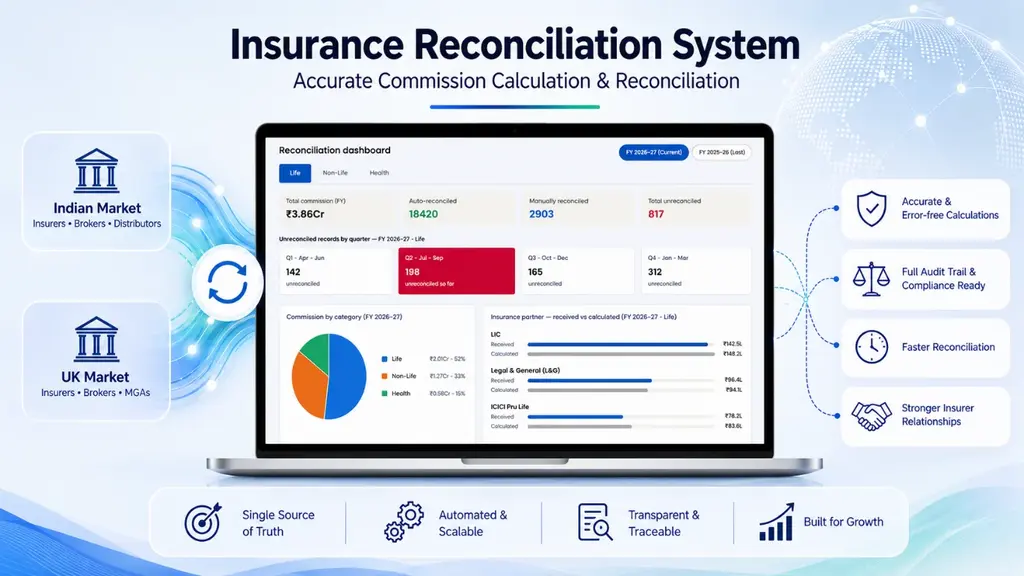
As insurance businesses expand across multiple insurers, product lines, brokers, and financial intermediaries, calculating and reconciling commissions grows more complex than spreadsheets and disconnected systems can handle. Every mistyped entry and every “we’ll check it later” mismatch carries a cost — in staff hours, compliance exposure, and strained insurer relationships. The Insurance Reconciliation System, built by Winsoft Technologies, removes that cost by automating commission calculation, data validation, and reconciliation on a single platform.
Where Commission Reconciliation Breaks Down
Fragmented, inconsistent data. Insurer details, product structures, and commission rates are often maintained separately across teams, with no single source of truth — so every calculation inherits that inconsistency.
Manual, error-prone processing. Large volumes of policy and transaction data are entered by hand, introducing errors that often go unnoticed until they’re far harder to fix.
Unverifiable figures. Commission calculated in spreadsheets typically lacks an audit trail, making discrepancies hard to trace — or to trust.
Lack of accountability. Without a structured review process, there’s often no record of who entered or approved master data — a liability during compliance reviews.
The result: finance and operations teams spend more time reconciling than analysing, while the organization carries ongoing compliance risk.
Is Manual Reconciliation Itself the Error?
Mismatches aren’t usually caused by a single mistake — they’re caused by the process used to catch them. When reconciliation depends on someone manually comparing spreadsheets line by line across thousands of policies, error isn’t the exception; it’s the expected outcome.
Manual reconciliation fails quietly. A missed row or an outdated rate doesn’t announce itself — it sits in the data until an audit or a revenue gap forces someone to go looking. By then, fixing it costs far more than preventing it would have.
The goal isn’t to make people more careful. It’s to remove manual matching from the process entirely.
How the Insurance Reconciliation System Closes the Gap
What’s needed is a single, centralized system that maintains accurate master data at the source, processes high transaction volumes reliably, calculates commission systematically, and reconciles it against insurer-reported figures automatically — with full traceability at every step. This is the Insurance Reconciliation System Winsoft Technologies has built. Every problem named above has a corresponding answer built into it.
Centralised masters solve fragmented data
The Insurance Reconciliation System maintains a single source of truth for insurer details, product and business-class hierarchies, premium frequencies, policy status codes, and payment methods — along with rate masters for Normal, Clawback, and Loyalty Commission, and an Event Master tracking lifecycle changes like In-Force, Lapsed, Cancelled, and Matured. When this data lives in one place, every downstream calculation inherits consistency.
Structured bulk uploads solve manual processing
Instead of hand entry, transaction volumes move through structured file uploads — similar in purpose to a Commission / Business Statement (often called a bordereaux), the standard submission format between brokers, MGAs, and insurers. Policy data, status, premium transactions, and payouts all follow the same validation logic: files are checked for quality, valid and invalid records are separated automatically, and a summary shows exactly what needs correction.
Maker-Checker solves unverifiable figures
No single person can create and finalise a record alone. The Insurance Reconciliation System applies a Maker-Checker model — the Four Eyes Principle, a dual control standard widely used across regulated financial services in India, the UK, and other markets. One user submits a record; another reviews and authorises or rejects it before it goes live.
Automated reconciliation solves undetected mismatches
Commission is calculated for a selected insurer and date range directly from validated transaction data, with exceptions flagged automatically. An automated reconciliation engine then compares calculated commission against what was actually received, sorting every record as Matched, Received but Not Calculated, Calculated but Not Received, or Partial Match. Nothing is left to chance discovery.
Full reporting solves lack of accountability
A detailed Reconciliation Report, exportable by class of business, insurer, and date range, shows exactly where every policy stands — premium amounts, received vs. calculated commission, policy status, and branch details. Combined with the maker-checker trail, this gives compliance and audit teams a clear, traceable record of who did what, and when.
Insurance Reconciliation System — Advantages That Solve the Problem
| Problem | How the Insurance Reconciliation System Solves It |
|---|---|
| Fragmented, inconsistent data | Centralised masters give every team the same source of truth |
| Manual, error-prone processing | Structured bulk uploads with automatic validation replace manual entry |
| Unverifiable commission figures | Maker-Checker dual control verifies every record before it goes live |
| Undetected mismatches | Automated reconciliation surfaces every mismatch |
| Lack of accountability | A full audit trail supports compliance and audit readiness |
The outcome: faster settlements, fewer errors, stronger audit readiness, and more transparent relationships with insurers — at a scale spreadsheets can’t sustain.
Conclusion
Commission calculation and reconciliation sit at the heart of the relationship between insurers and their distribution partners — getting it wrong, or too slowly, costs trust and efficiency. Winsoft Technologies’ Insurance Reconciliation System solves this with centralised master management, automated calculation, built-in reconciliation, and maker-checker controls — part of Winsoft’s broader work in Insurance Distribution Software and Digital Transformation in the BFSI Sector.
FAQs
Q2. What is the Maker-Checker principle?
A dual control mechanism where one user creates a record and another reviews and authorises it before it goes live — a standard control in regulated financial services, including India and the UK.
Q3. How does the system calculate commission?
Commission is calculated per insurer and date range from uploaded transaction data using predefined rate cards. Records that can't be processed cleanly are flagged for review.
Q4. How does automatic reconciliation work?
It compares calculated commission against commission received and classifies each record as Matched, Received but Not Calculated, Calculated but Not Received, or Partial Match.
Q5. What does the Reconciliation Report show?
A detailed, exportable view of every policy's reconciliation status — premium amounts, commission rates, received vs. calculated figures, and branch details.