Mutual fund distribution has grown considerably more complex over the past decade. Investors expect faster onboarding, banks and distributors are managing larger client bases, and reconciling revenue against registrar data has become a persistent operational challenge. Managing all of this manually, through paperwork and spreadsheets, is no longer realistic at scale.
This blog looks at how Mutual Fund Software is helping banks and distributors simplify fund distribution, and what capabilities actually make a meaningful difference in day-to-day operations.
Why Fund Distribution Has Outgrown Manual Processes
For years, mutual fund distribution relied heavily on paper-based onboarding, manual transaction tracking, and periodic reconciliation against registrar and transfer agent (RTA) data. This worked reasonably well at smaller volumes.
As distribution businesses have scaled, a few recurring challenges have become harder to ignore:
- Onboarding new investors takes longer than it should due to paper-heavy processes.
- Reconciling income and commission data against RTA records is time-consuming and error-prone.
- Advisors and relationship managers often lack real-time visibility into client portfolios.
- Revenue leakage from unnoticed reconciliation errors can go undetected for months.
These aren’t isolated inconveniences, they compound as transaction volumes grow, eventually reaching a point where manual processes simply can’t keep pace.
What Does Mutual Fund Software Actually Cover?
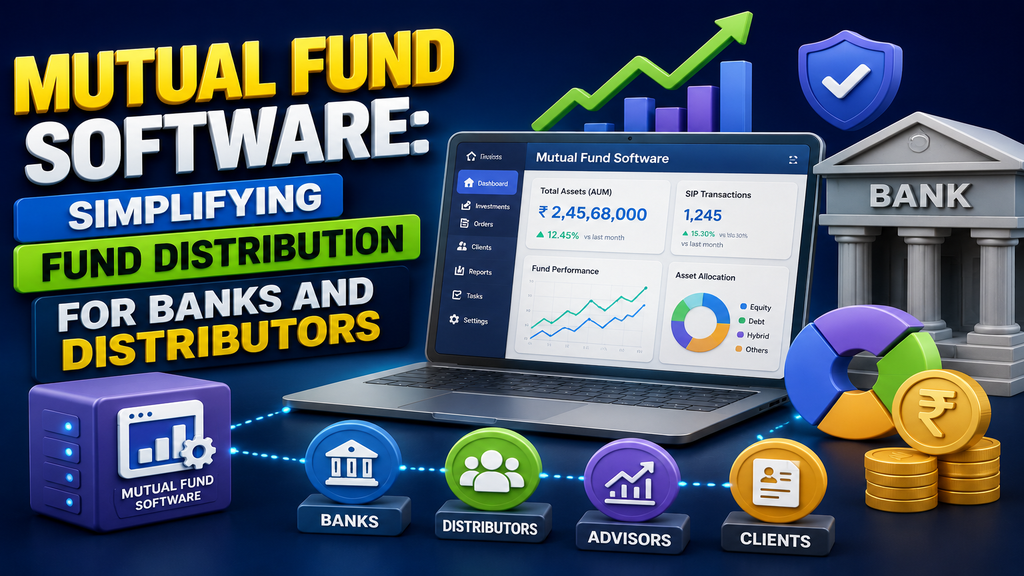
At its core, this software digitises the operational backbone of mutual fund distribution through three connected portals: a customer-facing portal, an advisor/RM portal, and an operations portal, each supporting a different part of the distribution workflow, alongside business-wide MIS reporting.
The Customer Portal
This is where investors interact directly with their portfolio. Capabilities here typically include instant digital onboarding with eKYC and risk profiling, a comprehensive portfolio dashboard, digital goal planning and tracking, and instant execution of both lumpsum and systematic transactions. Investors also get performance analytics and alerts, support for non-financial transactions, responsive design for handheld devices, call centre-assisted transactions, and a cart facility for managing multiple fund selections at once.
The Advisor/RM Portal
Relationship managers work from a dedicated dashboard offering a comprehensive view of customer portfolios with analytics, along with RM-specific reports. This portal supports RM-assisted onboarding, re-risk profiling, and transaction execution, as well as scheduling of reports and alerts. It also includes prospect and campaign management, along with tools for tracking RM targets and incentives.
The Operations Portal
This is where the heavier back-office work happens: integration with data service providers and existing core systems, rule-based revenue calculation covering upfront, annualised, trail, incentive, and claw-back structures, and automated revenue reconciliation. It also handles seamless order processing through RTA and BSE Star interfacing, customer portfolio returns calculation, RTA reverse feeds for transactions, NAV, and income data, along with customisable reporting and integration with document management systems.
Business MIS
At a business level, reporting covers assets under management, mobilisation, income, active systematic investment plans, and both year-to-date and month-to-date performance, including zone-wise business breakdowns.
Why Does This Matter for Both Banks and Distributors?
A fair question is whether banks and independent distributors have fundamentally different needs when it comes to this kind of software.
In practice, both face similar operational pressures, they need to onboard investors efficiently, serve clients across multiple channels, and reconcile revenue accurately. What differs is scale and structure. Banks often manage mutual fund distribution as one line of business among several, sitting alongside offerings like insurance, where Bancassurance Software handles a similarly structured, multi-partner distribution model, requiring seamless integration with core banking and third-party systems. Independent distributors, by contrast, may rely on the mutual fund platform as their primary operational backbone. Software designed to serve mid and large distributors, as well as banks and financial institutions, needs to accommodate both scenarios without forcing either into an ill-fitting structure.
How Does This Reduce Operational Strain?
When onboarding, reporting, and reconciliation are automated rather than manual, the impact extends beyond time savings. Staff who previously spent significant time on paperwork and manual cross-checking can redirect that time toward client engagement and business development. Relationship managers walk into client conversations with current portfolio data rather than outdated reports, supported by RM target and incentive tracking that keeps performance visible. And discrepancies in revenue calculation, across upfront, trail, incentive, or claw-back structures, get flagged early through automated reconciliation, rather than discovered much later during an audit.
This shift, from reactive problem-solving to proactive, automated processing, is often what separates distribution businesses that scale smoothly from those that struggle under their own growth. For institutions implementing or scaling this kind of system, IT Staff Augmentation offers a practical way to bring in the specific technical expertise needed during setup or expansion, without adding long-term headcount for a need that may be temporary.
Conclusion
Fund distribution for banks and distributors has moved well beyond what manual processes can reasonably support. Mutual Fund Software built around digital onboarding, multi-portal engagement across customers, advisors, and operations, automated revenue reconciliation, and structured business reporting forms the operational foundation modern distribution businesses need. For banks and distributors looking to reduce administrative strain while improving accuracy and client experience, this kind of purpose-built platform isn’t simply a convenience, it’s increasingly the standard for how fund distribution gets done efficiently at scale.
FAQs
1. What is mutual fund software used for?
It digitises mutual fund distribution operations through connected customer, advisor, and operations portals, covering onboarding, transaction execution, revenue reconciliation, and reporting.
2. Is this software suitable for both banks and independent distributors?
Yes, it’s typically built to serve mid and large distributors as well as banks and financial institutions, with integration support for core banking and third-party systems.
3. How does this software help with revenue accuracy?
It applies rule-based revenue calculation across upfront, annualised, trail, incentive, and claw-back structures, with automated reconciliation against RTA data to catch discrepancies early.
4. What can investors do through the customer portal?
Investors can complete digital onboarding with eKYC, track goals, execute lumpsum and systematic transactions, view portfolio analytics, and manage selections through a cart facility.
5. How does this software support relationship managers specifically?
RMs get a dedicated dashboard with portfolio analytics, RM-assisted onboarding and transaction tools, prospect and campaign management, and tracking for their own targets and incentives.