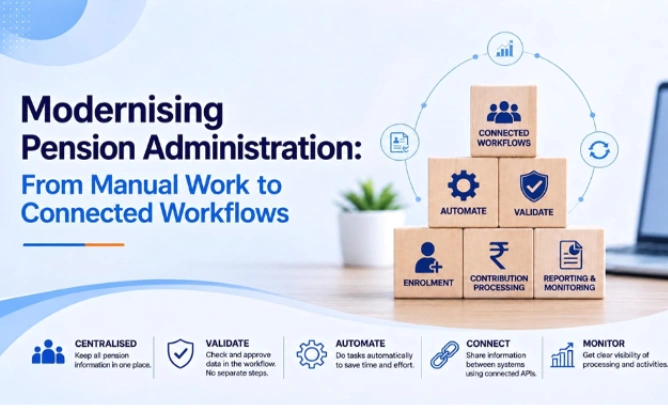
Pension administration involves a series of connected operational activities, from enrolment and eligibility validation to contribution processing, transaction management and reporting. When these activities depend heavily on manual intervention or disconnected processes, organisations need a more structured way to manage the complete processing journey.
Where Pension Administration Becomes Challenging
Manual enrolment and processing
Pension enrolment can involve multiple registration and processing steps. When these activities are handled manually, operational teams may need to repeat the same tasks across different stages.
Eligibility validation
Eligibility information needs to be checked as part of the enrolment process. Managing these checks separately can add additional effort to the overall processing journey.
Contribution and SI processing
Recurring contributions and Standing Instructions (SI) require consistent processing. When these activities are managed manually, maintaining a connected workflow becomes more challenging.
Pension transaction management
Pension administration continues beyond enrolment. Related transactions need to be processed and managed efficiently while remaining connected to the overall pension journey.
The Impact of Manual Processing
When pension activities are managed through separate manual steps, teams can spend significant operational effort on data entry, validation and transaction handling.
The challenge is therefore not limited to one individual activity. The wider requirement is to bring connected pension processes together and reduce unnecessary manual intervention across the workflow.
How Technology Can Address These Requirements
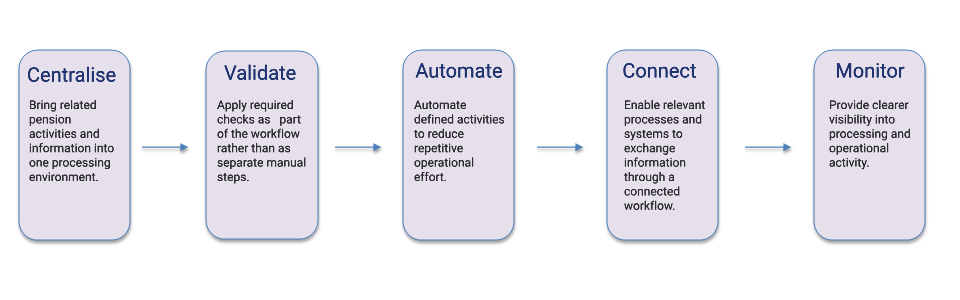
A centralised approach brings related pension activities into one connected processing environment and supports automation across defined stages.
A Practical Example: Addressing a Pension Processing Challenge
A bank approached Winsoft Technologies with a requirement to improve the processing of APY (Atal Pension Yojana, a pension scheme in India). The bank needed a more centralised way to manage customer enrolment, eligibility validation, contribution and Standing Instruction (SI) processing, and related pension transactions.
Although the requirement was specific to APY, the underlying challenge is common to pension administration: multiple processing activities and systems need to work together efficiently while reducing dependence on manual processing.
The Requirement
The requirement was to digitise the APY registration and processing activities, reducing reliance on manual work while bringing the relevant stages into a more connected processing environment.
This included customer registration and enrolment, eligibility validation, contribution and Standing Instruction (SI) processing, and related pension transactions. The aim was to improve coordination between the systems involved and create a more consistent digital workflow.
How Winsoft Addressed the Requirement
Winsoft Technologies addressed the requirement through SmartAPY, a browser-based solution supporting both Front Office and Back Office APY processing.
The solution brought the relevant processing activities together within a centralised workflow, while API-based connectivity enabled information to be exchanged between the relevant systems. This helped automate defined activities and reduce the need for repetitive manual intervention.
The APY processing journey can be represented as:
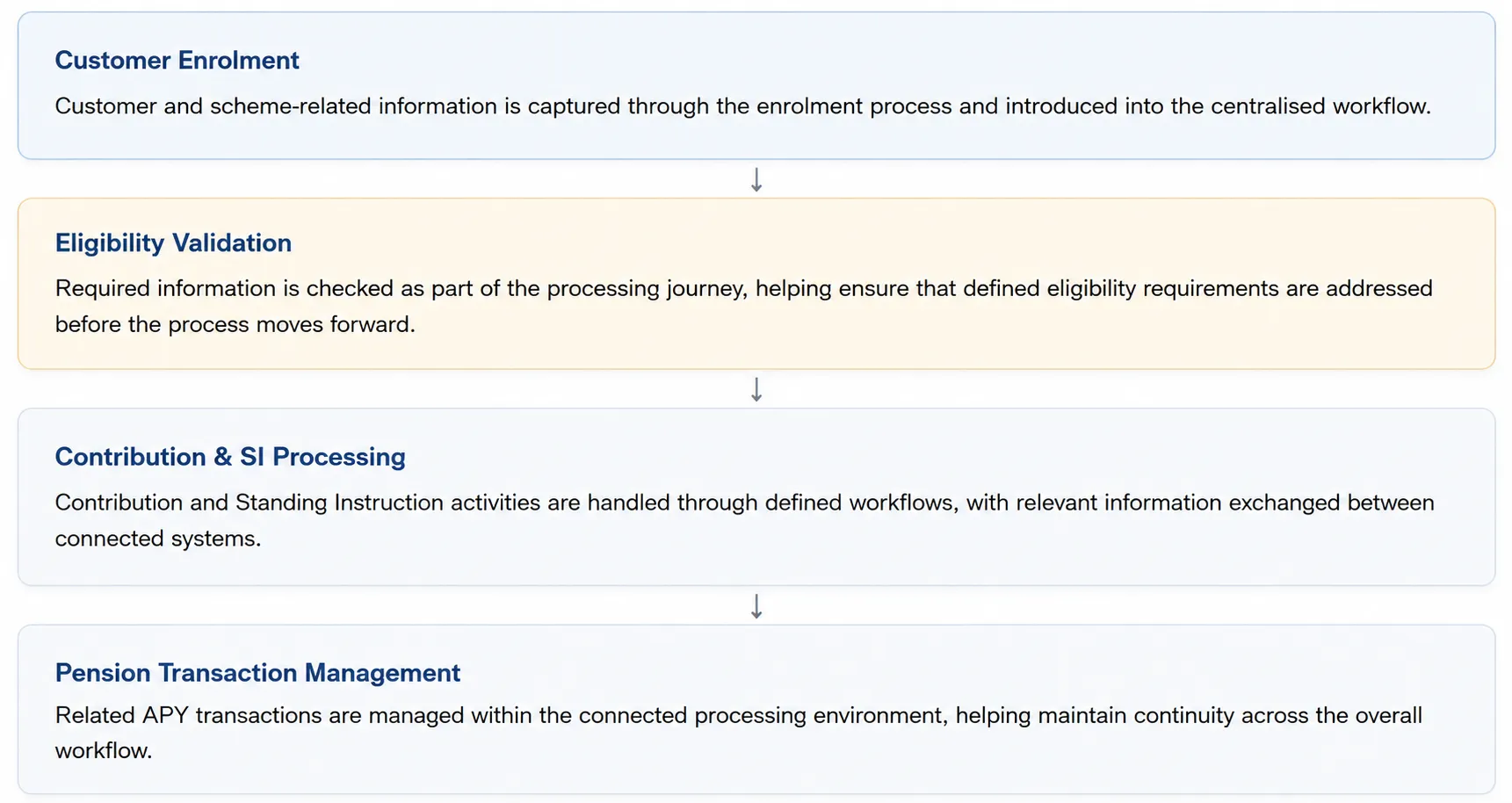
By connecting these stages within a structured workflow, the approach supported a more consistent end-to-end processing journey.
The Outcome
The approach helped reduce manual intervention in APY registration and processing while bringing related activities into a more connected workflow. It also provided a more structured way to manage the processing journey across the relevant systems.
While the example is based on APY in India, the underlying approach is relevant to pension administrators and financial organisations in other markets facing similar challenges around manual processing, disconnected systems and workflow management.
Beyond a Single Pension Scheme
The requirement demonstrated through APY reflects a broader need within pension administration.
Different pension schemes and products may operate under different rules, eligibility requirements and transaction processes. However, the underlying technology requirements can be similar: centralised processing, connected systems, workflow automation, validation and operational visibility.
A technology approach built around these requirements can therefore support organisations looking to modernise pension administration without being limited to one particular pension scheme.
Conclusion
Pension administration involves multiple activities that need to work together efficiently. When these activities depend heavily on manual intervention or disconnected processes, organisations can benefit from bringing them into a more structured and connected workflow.
The practical example demonstrates how a pension-processing requirement can be addressed by centralising activities, connecting systems through APIs and automating defined workflows. The same principles can be applied more broadly to organisations looking to improve the way they manage pension operations.
FAQs
Q2. What are the common challenges in pension administration?
Common challenges can include manual enrolment, eligibility validation, contribution processing, transaction management and the need to coordinate information across different systems.
Q3. How can technology reduce manual intervention in pension processing?
A centralised workflow can automate defined activities and connect related processing stages, reducing repetitive manual intervention.
Q4. How can APIs support pension administration?
APIs can enable relevant systems to exchange information, helping connect different stages of a pension-processing workflow and reduce the need for separate manual data handling.
Q5. How can a centralised pension workflow improve operations?
It brings related activities into a connected processing environment, helping organisations manage workflows more consistently while improving operational visibility.