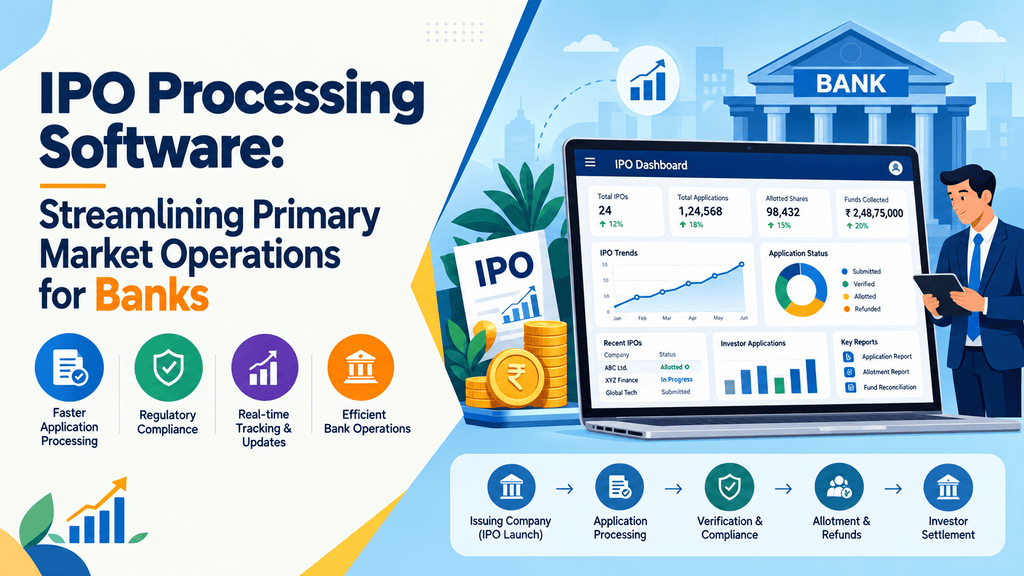
Every time a company launches an IPO, FPO, NCD, NFO, or Rights Issue in India, banks sit at the center of the action — collecting applications, blocking funds through ASBA, coordinating with exchanges, and reconciling thousands (sometimes lakhs) of applications within tight regulatory timelines. For a bank, this isn’t a once-a-year event; with India’s active primary market, it’s a recurring operational cycle that demands accuracy, speed, and audit-readiness every single time. Managing this manually, or with fragmented tools, is where banks run into bottlenecks, reconciliation errors, and compliance risk. This is exactly the problem purpose-built IPO Processing Software is designed to solve.
Why Primary Market Processing Needs Dedicated Technology
Primary market applications aren’t a simple, single-step transaction. An IPO or NCD application moves through registration, verification, fund blocking, allotment, and reconciliation — often across multiple channels and involving coordination between the bank’s core systems, the exchanges (NSE and BSE), and depositories. Winsoft’s SmartASBA was built specifically around this reality: a comprehensive digital platform for IPO, NFO, Debt/NCD, and Rights Issue products that digitizes primary market application processing so financial distributors can handle, support, and service their clients without the operational chaos that comes with manual processing.
The platform’s core purpose is straightforward but critical: automated processing of bulk Primary Market applications, supporting hassle-free investments through ASBA, Syndicate ASBA, and Physical/Non-ASBA applications — covering the full range of ways investors actually apply for primary market products in India today.
Back Office: The Operational Backbone
The Back Office module is where the heavy lifting of IPO processing happens. It manages the primary market schemes themselves — IPO, FPO, DEBT/NCD, NFO, and Rights Issue — from a single administrative layer. What makes this particularly useful for banks is the depth of integration built into it:
- Integration with Core Banking Systems like Finacle and FlexCube, handling lien marking, lien removal, and fund transfer automatically — eliminating the manual coordination that typically happens between a bank’s IPO team and its core banking operations team.
- Integration with SMS/Email gateways and online PAN verification via NSDL, along with an application registration API for third-party brokers, so applications coming through broker channels don’t require separate manual entry.
- Bulk upload support for application forms, which matters enormously during high-volume issues where thousands of applications need to be processed within a narrow window.
- API and file-based interfaces with NSE and BSE for application processing, keeping the bank’s system in sync with exchange requirements without manual file handling.
- Maker/Checker controls across all masters and transactions, satisfying the audit and security requirements that any bank handling investor funds must meet.
- Dispatch management covering registration, verification, and acceptance stages, so the status of every application is tracked and auditable.
- Cut-off time management for HNI and retail categories, applied consistently across branches and the central office — critical because primary market issues have strict regulatory cut-off windows that differ by investor category.
- The ability to handle modifications in application data post issue closure, and comprehensive reconciliation for both applications and funds processed — arguably the single most important capability for a bank, since reconciliation errors in primary market processing carry direct financial and regulatory consequences.
Branch Office: Where Applications Actually Get Processed
While the Back Office handles scheme-level administration, the Branch Office module is where day-to-day application handling happens. It supports both bidding and fixed-price issues, covering the two primary structures IPOs and other primary market products can take. Branch staff get:
- Application entry, modification, verification, and cancellation capabilities directly at the branch level
- A dashboard for monitoring the application registration-to-allotment process, giving branch and central teams real-time visibility into where every application stands
- An application form printing module, supporting the physical/non-ASBA application channel alongside digital ones
This combination means a bank’s branch network can process primary market applications consistently, whether the investor applies digitally or in person.
ASBA On-Net: Extending Access Through Digital Channels
Beyond the branch counter, ASBA On-Net extends primary market access through digital channels — which is increasingly where investor demand sits. This module includes:
- A scheme and application dashboard for digital visibility
- Beneficiary registration and modification capabilities
- Application bid, rebid, and withdrawal functionality — important because investors frequently need to revise their bids before an issue closes
- API-based interfaces for mobile, enabling investment through handheld devices
- Seamless integration with the retail banking portal, so investors can apply for IPOs and other primary market products through the same digital banking experience they already use
Together with the Back Office and Branch Office, this gives banks multiple digital application channels — investors can invest through internet banking, handheld devices, or channel partners, all feeding into the same processing backbone.
Business Reports: Built for Regulatory Scrutiny
Primary market processing is one of the most heavily scrutinized areas of capital market operations, and the Business Reports module reflects that. It includes MIS reports, audit reports, posting reports, SEBI reports, product-wise reports, and compliance reports as per the requirements of SEBI, NSE, and BSE. For a bank’s compliance and audit teams, having these reports generated directly from the processing platform — rather than assembled manually after the fact — significantly reduces both the effort and the risk involved in regulatory reporting.
Key Benefits for Banks and Financial Distributors
Pulling these modules together, SmartASBA delivers a set of practical operational benefits:
- Support for bulk imports of application requests, essential during high-subscription IPOs
- Fully automated, web-based, open-source architecture, reducing dependency on legacy infrastructure
- API-based architecture that integrates with brokers and securities channels for application processing through the back office
- Granular-level user access control, supporting internal security requirements
- Web-responsive user interface, usable across devices
- SMS and email alert support, keeping both staff and investors informed throughout the application lifecycle
- Automated income and commission calculation, which simplifies billing and invoice generation — a process that’s traditionally manual and error-prone when done issue-by-issue
- Accurate, comprehensive reconciliation, ensuring the application-to-fund workflow closes cleanly every time
Fitting IPO Processing Into a Bank’s Broader Technology Strategy
Primary market processing rarely sits in isolation from a bank’s wider technology roadmap. Banks that invest in dedicated IPO processing infrastructure are often doing so as part of a broader Digital Transformation Services initiative — modernizing capital market operations alongside core banking, retail digital channels, and other business lines simultaneously, rather than treating IPO processing as a standalone upgrade.
Given how integration-heavy a platform like SmartASBA is — connecting to core banking systems, exchanges, depositories, and broker networks — implementation often requires additional technical bandwidth during rollout. This is where banks frequently rely on IT Staff Augmentation to bring in the technical resources needed for integration and testing phases, without committing to long-term hiring cycles.
It’s also worth noting that this same integration-first approach extends across Winsoft’s capital market suite. Just as SmartASBA connects primary market processing directly into a bank’s core systems, Winsoft’s broader Banking Technology Solutions suite is built around the same principle — giving banks purpose-built, deeply integrated platforms for each capital market function rather than forcing generic software to handle specialized, high-volume, regulation-heavy processes.
Conclusion
IPO and primary market processing is high-stakes, high-volume, and tightly regulated — which makes it a poor fit for manual processes or generic financial software. SmartASBA’s Back Office, Branch Office, ASBA On-Net, and Business Reports modules together give banks and financial distributors a single, integrated platform to manage the entire application lifecycle — from bulk registration and core banking integration to SEBI-compliant reporting and accurate reconciliation — turning what used to be a high-risk manual process into a streamlined, auditable digital workflow.