There is a particular kind of inefficiency that only shows up once you watch a process in person. Not in a systems diagram, not in a workflow chart — but in the everyday reality of someone physically carrying a sealed envelope from a bank branch to a clearing house, because that is how it has always been done.
For one Japanese MNC bank operating in India, that process was Fixed Deposits for collateral management of foreign institutions that invest in Indian markets. The task on paper looked narrow: modernise how Fixed Deposit receipts were created, renewed and closed. In practice, it became a case study in what digital transformation actually requires — not just replacing paper with a screen, but rebuilding the operating model around control, traceability and integration.
The Problem Behind the Problem
The bank’s existing process required staff to physically collect sealed FD receipts from branches and hand-deliver them to NSCCL, India’s clearing corporation, for every creation, renewal or closure. Each transaction depended on someone being in the right place, at the right time, with the right paperwork. It worked — but it was slow, resource-intensive, and offered almost no real-time visibility into where any given FD stood in its lifecycle.
This is a familiar shape of problem for banking operations teams anywhere. Wherever a transaction still depends on physical movement of a document between two institutions, three things tend to follow: it’s slow, it’s hard to audit in real time, and it quietly consumes far more operational headcount than anyone budgets for.
Reimagining the Workflow, Not Just Digitising the Document
The instinct in many transformation projects is to scan the paper and call it done. We took a different starting point: what would this process look like if it were designed digital-first, with the same governance rigour a bank’s compliance function would demand?
That meant redesigning the workflow around a few core principles:
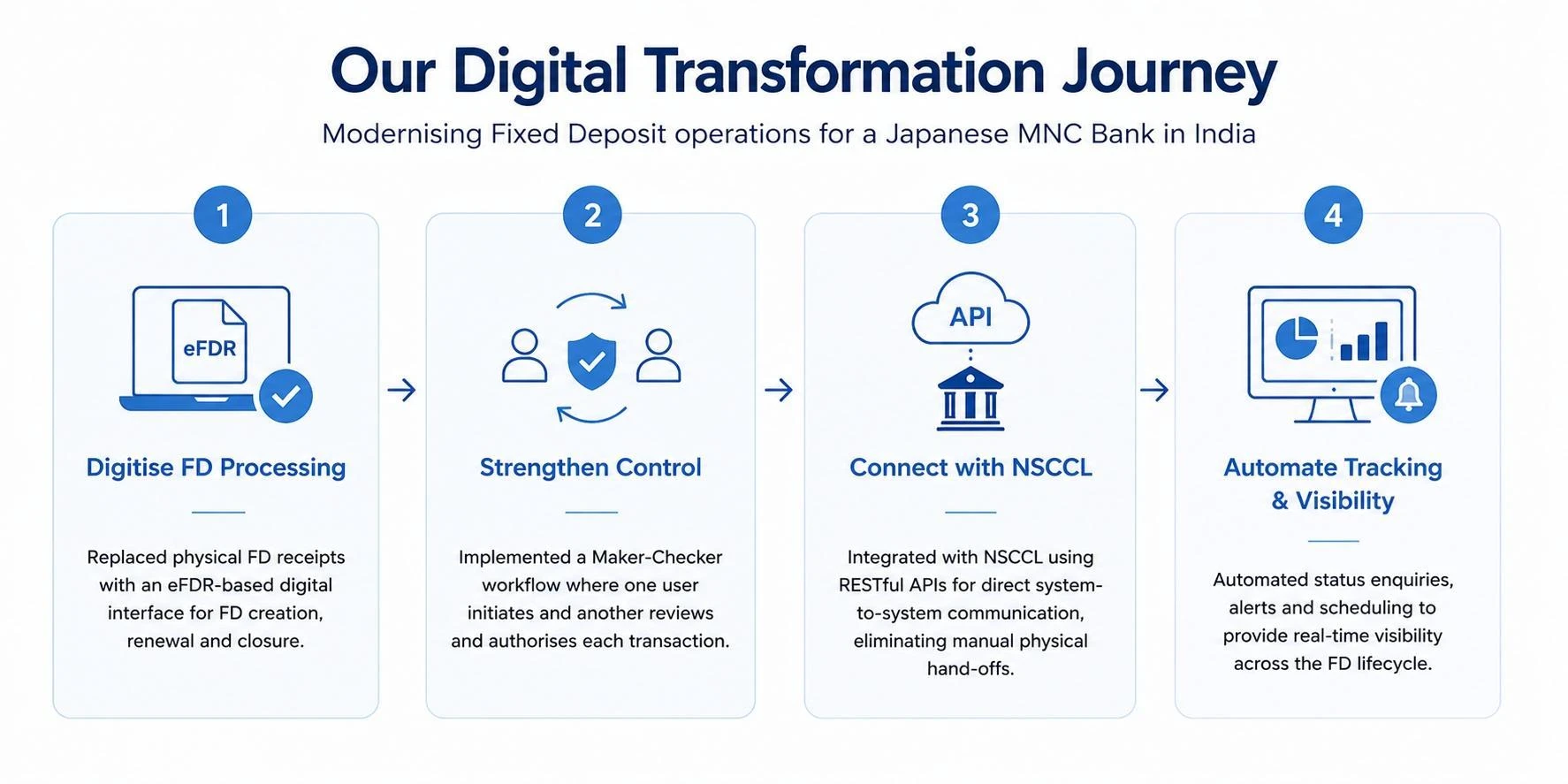
Replace physical movement with structured digital data. An eFDR-based interface now handles FD creation, renewal and closure electronically, removing the courier step entirely.
Integrate directly with market infrastructure. Rather than digitising the paperwork and still routing it manually, the solution connects to NSCCL through RESTful APIs — so FD creation, renewal and release happen as system-to-system transactions, not human hand-offs.
Keep human judgement where it matters, and only there. A Maker-Checker workflow ensures one user initiates a transaction and a second reviews and authorises it before it goes anywhere near NSCCL. Rejections are logged with reasons, so nothing disappears into a black box.
Make status a fact, not a follow-up call. Automated status enquiries and background scheduling track FD release progress and trigger alerts to the operations team the moment something changes — no more chasing updates.
Secure access the way an enterprise IT function expects. Active Directory-based authentication with group-based role mapping means access to each function is governed centrally, not managed through informal permissions.
The Pattern Underneath the Product
Strip away the specifics of FD operations and NSCCL, and a repeatable transformation pattern emerges — one that applies to a wide range of paper-dependent banking processes, not just this one:
Paper & Physical Movement → Digital Data Capture → Maker-Checker Control → API Integration → Automated Status Tracking → Alerts & Reporting
This is the sequence that matters more than any single product name. It’s the difference between digitising a document and re-engineering an operating model.
Why This Matters Beyond One Bank
Operational reports, API status reporting, consolidated FD reporting and full transaction/user activity logs now give the bank’s teams a live view of the FD lifecycle — the kind of visibility that used to require manual reconciliation, and now exists as a by-product of how the system is built.
The underlying challenge — legacy, paper-intensive processes sitting inside otherwise modern banks — is not unique to one institution or one market. Many banking operations teams, including here in the UK, are managing some version of the same problem: a critical process that still depends on physical documents, manual sign-off chains, or systems that don’t talk to each other. The tools differ by geography and regulation, but the underlying transformation logic — capture digitally, control deliberately, integrate directly, track automatically — holds regardless of which market it’s applied in.
That’s the capability this project really demonstrates: not a single product, but an approach to taking operationally critical, paper-bound banking processes and rebuilding them as connected, auditable, integration-ready digital workflows — without losing the controls a bank is required to have in the first place.