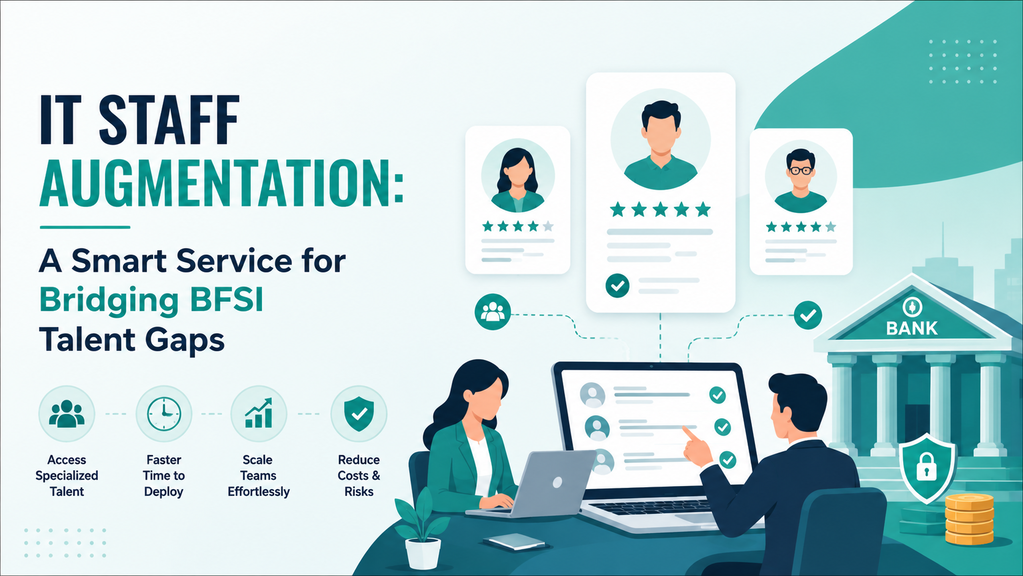
A mid-sized bank rolling out a new digital lending platform. An asset management company upgrading its trading interface before a regulatory deadline. An insurer building out a servicing portal for a growing policy book. None of these projects can wait six months for a hiring process to run its course, yet each one needs people who already understand how BFSI systems actually work, not developers learning the sector from scratch.
IT Staff Augmentation exists precisely for this gap, giving BFSI companies a way to bring in skilled technical resources quickly, without the extended timeline that comes with building a permanent team from the ground up.
The Kind of Projects This Typically Supports
This isn’t a one-size-fits-all service applied to any technical need. It tends to show up specifically in projects tied to:
- Short-term initiatives with a defined scope and a fixed deadline.
- Specialised platform work, core banking applications, Digital Banking Solutions, trading systems, or servicing portals, where general developers would need significant ramp-up time.
- Periods of fluctuating demand, such as regulatory reporting cycles or new product launches, that don’t justify permanent hires.
- Strengthening an existing core team temporarily, without long-term headcount commitments.
Why Domain-Specific Resources Make a Measurable Difference
A company evaluating this service is really asking one practical question: will bringing in external resources actually save time, or just move the learning curve somewhere else?
The answer depends heavily on domain fit. Resources with prior, hands-on experience across banks, asset management companies, NBFCs, insurance companies, and broking firms bring working knowledge of large-sized databases, Microsoft technologies, and specific BFSI functions, life and general insurance, pension schemes, mutual funds, Investment Management Software, demat operations, analytics reporting, and broader financial management software solutions. That kind of familiarity means a resource can start contributing to a project within days, rather than spending the first few weeks simply understanding how the business operates.
This becomes especially clear in specialised, high-stakes environments. A developer with prior exposure to IPO Processing Software, for instance, already understands concepts like application volume spikes, fund blocking logic, and exchange-linked processing timelines, context that would otherwise take considerable time to build from zero on a live, time-sensitive project.
How Engagements Are Typically Structured
Most engagements run on a Time & Material contract model. Rather than fixing the entire scope of work upfront, teams work closely with the client to build a project plan delivered across smaller, more manageable timelines, giving both sides room to adjust as the work progresses.
Under this model, billing is tied to actual time spent on development, and the client retains a more active role in shaping direction compared to a fixed-price arrangement. This tends to suit BFSI projects particularly well, since requirements can shift, a compliance clarification changes a spec, or early testing reveals a new priority, without needing to renegotiate the entire engagement each time.
What This Approach Solves in Practical Terms
Stripped down to the essentials, this service tends to address a specific set of recurring business problems:
- Slow recruitment cycles that don’t match how quickly BFSI projects need to move.
- Higher development costs associated with hiring permanently for temporary or specialised work.
- Legal and administrative overhead that comes with direct employment arrangements.
- Geographical hiring limitations, when the right skillset isn’t available locally.
- Rigid team structures that can’t easily expand or contract as project needs change.
Where the Value Shows Up Over Time
Companies that use this service well tend to treat it as a genuine extension of their internal team, not a separate, disconnected group working in isolation. Augmented resources typically integrate into existing workflows and reporting structures, contributing toward the same deadlines and standards as permanent staff.
Over time, this flexibility tends to compound. A company can expand its technical capacity quickly when a new initiative demands it, and just as easily scale back down once that specific need has passed, without carrying the cost of permanent headcount built around a temporary requirement.
Conclusion
BFSI companies rarely face a shortage of technical talent in the abstract, they face a shortage of the right talent, available on the timeline a project actually needs. IT Staff Augmentation closes that specific gap, giving institutions access to professionals who already understand the sector’s systems and compliance context, engaged through a model flexible enough to adapt as project requirements evolve. For companies facing deadlines that standard hiring simply can’t meet, this remains one of the more practical ways to keep specialised BFSI projects moving forward.
FAQs
1. What kinds of BFSI projects benefit most from IT staff augmentation?
Projects with defined scopes and tight deadlines, specialised platform work, and periods of fluctuating technical demand tend to benefit most, since permanent hiring often can’t match these timelines.
2. Why does domain-specific experience matter so much in BFSI staffing?
Resources with prior exposure to banking, insurance, or investment platforms can start contributing within days, since they don’t need to learn the sector’s operational context from scratch.
3. How is billing typically structured for these engagements?
Most engagements follow a Time & Material contract, where companies are billed for actual time spent on development, offering more flexibility than a fixed-price project.
4. Does augmented staff replace a company’s internal technology team?
No, augmented resources typically work as an extension of the existing team, integrating into current workflows rather than operating as a separate unit.
5. Can a company scale its augmented team down once a project ends?
Yes, one of the core advantages of this approach is the ability to scale up for a specific need and scale back down once that work is complete.