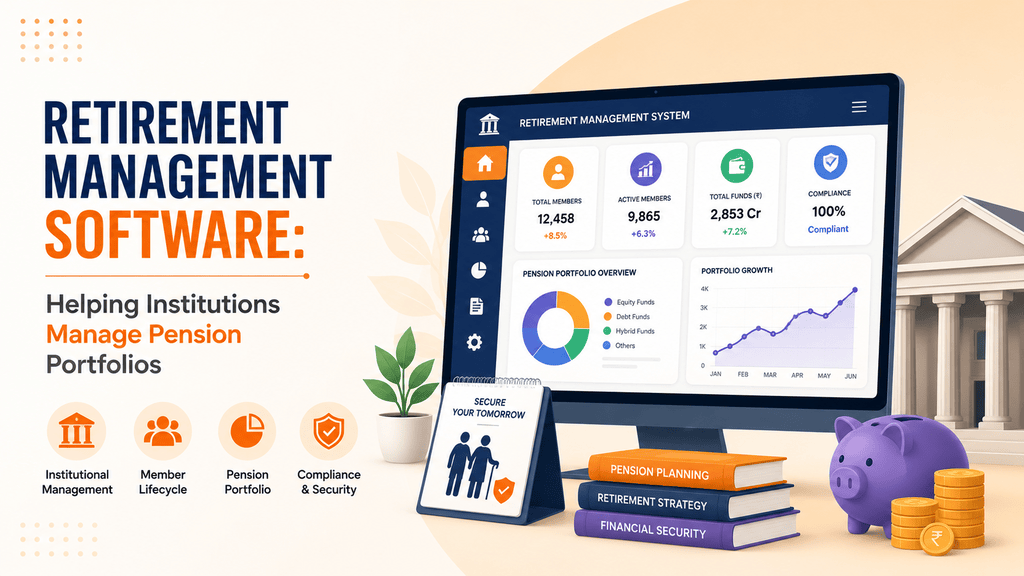
Retirement planning in India spans a genuinely wide range of subscribers, government employees, private sector professionals, and workers in the unorganised sector alike, each engaging with different pension products under different rules. For the banks and financial institutions serving these subscribers, managing this range of pension offerings through disconnected, manual processes becomes increasingly difficult as subscriber volumes grow.
Retirement Management Software exists to bring structure to this responsibility, giving institutions a way to manage pension portfolios across products, from registration through to ongoing servicing, within a connected system.
Why Institutions Need a Broader Approach to Pension Administration
Financial institutions rarely serve subscribers under just one pension scheme. Many manage a portfolio of retirement products simultaneously, each with its own registration process, contribution rules, and reporting requirements. Handling this range manually, through separate spreadsheets or disconnected systems for each product, creates unnecessary complexity and increases the risk of errors as subscriber numbers scale.
A more structured approach typically supports:
- Subscriber registration and onboarding across multiple pension products.
- Bulk instruction processing for contributions and account updates.
- Business MIS reporting to track subscriber activity and portfolio health.
- Both Back Office processing and Front Office sales capability within one system.
Supporting Different Pension Products Under One Structure
Institutions serving retirement-focused subscribers often need to manage more than one government-backed scheme at once. For subscribers investing through the National Pension System, institutions typically rely on National Pension Scheme Software to handle automated subscription and processing of investments, supported by seamless Back Office processing alongside Front Office sales capability.
For institutions also serving subscribers under the unorganised sector’s pension scheme, a separate but complementary system, commonly referred to as Atal Pension Yojana Software, handles the specific registration, contribution, and reporting requirements unique to that scheme. Because eligibility rules, contribution structures, and reporting requirements differ meaningfully between these schemes, institutions benefit from software that respects these differences rather than forcing every pension product through an identical, one-size-fits-all workflow.
How This Helps Institutions Manage Pension Portfolios More Effectively
Bringing multiple pension products under a coordinated technology structure changes how institutions actually operate day to day. Subscriber registrations move through digital workflows rather than manual paperwork. Bulk instructions, whether contribution processing or account updates, can be handled at scale rather than one record at a time. And business MIS reporting gives institutions a current view of subscriber activity and portfolio performance across products, rather than requiring separate reports pieced together manually for each scheme.
This matters particularly for institutions serving senior citizens and long-term subscribers, where accuracy and consistency directly affect the retirement outcomes these subscribers are relying on.
Why Online Subscriber Services Matter
Beyond back-office processing, subscribers themselves benefit from being able to manage their registrations and subscriptions online rather than depending entirely on branch visits. Institutions offering this kind of self-service access, alongside traditional branch support, tend to serve a broader range of subscriber preferences, from those comfortable managing accounts digitally to those who still prefer in-person assistance.
Conclusion
Managing pension portfolios across different retirement products requires more than a single, generic system, it requires software that respects the distinct rules of each scheme while still giving institutions a unified way to manage registrations, contributions, and reporting. Retirement Management Software built around this structure helps institutions serve senior citizens and long-term subscribers with greater accuracy and consistency, regardless of how many pension products they administer. For institutions managing this responsibility at scale, this kind of coordinated approach isn’t just operationally convenient, it directly supports the reliability subscribers depend on for their long-term retirement security.
FAQs
1. What does retirement management software actually help institutions do?
It helps institutions manage pension portfolios across multiple products, covering subscriber registration, bulk instruction processing, Back Office and Front Office operations, and Business MIS reporting.
2. Can one platform handle different pension schemes with different rules?
Yes, institutions typically use scheme-specific software, such as tools built around the National Pension System or Atal Pension Yojana, within a broader retirement management structure that respects each scheme’s distinct requirements.
3. Why is bulk instruction processing important for pension administration?
As subscriber numbers grow, processing contributions and account updates one at a time becomes unmanageable. Bulk processing allows institutions to handle these updates efficiently at scale.
4. Do subscribers need to visit a branch to manage their pension accounts?
No, institutions offering online subscriber services allow registrations and subscriptions to be managed digitally, alongside traditional branch-assisted support for those who prefer it.
5. What role does Business MIS reporting play in pension portfolio management?
It gives institutions a current, consolidated view of subscriber activity and portfolio performance across different pension products, rather than relying on separate manual reports for each scheme.