Administering Atal Pension Yojana at a bank branch involves far more than collecting a monthly contribution. It means registering subscribers correctly, executing recurring debits without fail, staying compliant with PFRDA (Pension Fund Regulatory and Development Authority) and FATCA (Foreign Account Tax Compliance Act) regulations, and keeping subscriber records accurate for a scheme that can run for decades. Atal Pension Yojana Software exists to bring structure to this exact set of responsibilities.
This blog looks at what this kind of software actually covers, based on how it’s built to support banks administering APY at scale.
What Is Atal Pension Yojana Software?
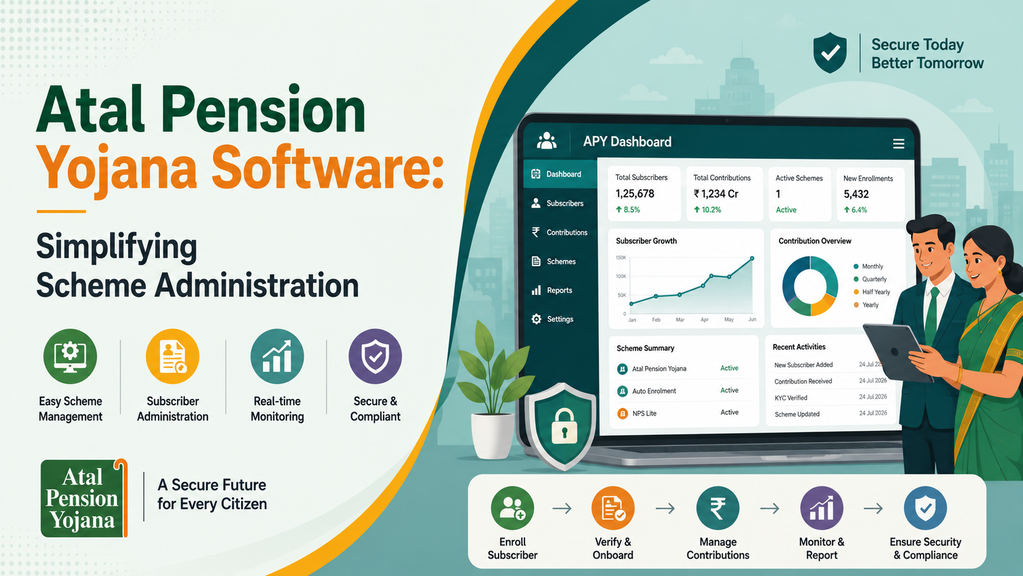
At its core, this is a browser-based platform offering Back Office and Front Office processing of APY contributions, built specifically to help financial distributors serve their clients’ retirement needs under this government scheme. It’s designed around three practical goals: making subscription easy through auto-debit facilities, keeping the total cost of managing APY distribution low, and supporting subscribers whether they engage through a bank branch or online. It typically works alongside other retirement-focused tools, such as National Pension Scheme Software, within an institution’s broader Pension Management Software setup, though each is built around the specific rules of the scheme it serves.
Key Capabilities That Drive Day-to-Day Administration
Subscriber Registration and Recurring Debits
The software captures and processes APY registration requests along with the subsequent recurring debit of contributions, built to handle large subscriber volumes rather than one-off registrations. Standing instruction (SI) debit execution can run on either a FIFO basis or a lump sum basis, depending on what a client institution requires.
Digital Onboarding Through e-NPS and Aadhaar eKYC
Subscriptions can be accepted through the e-NPS platform using Aadhaar-based eKYC, reducing dependence on physical paperwork for onboarding. The platform also maintains a PRAN library and interfaces directly with NSDL for SRF, SCF, and SMF file generation, keeping subscriber records aligned with central systems.
Regulatory Compliance Built Into the System
APY administration carries specific regulatory obligations, and the software is built to support APY FATCA regulations alongside PFRDA compliance requirements, rather than leaving these checks to manual oversight.
Integration With Core Banking and Mobile Channels
The platform integrates with a bank’s core banking system through APIs, and also connects with internet banking through APY On Net application integration. A separate API is available for integration with a bank’s retail mobile application, extending APY access to whichever channel a subscriber prefers to use.
Operational Controls That Support Accuracy
Beyond the customer-facing side, the software includes a set of operational safeguards designed for the sensitivity of long-term pension administration:
- Two-way security and data checks through a Maker/Checker workflow.
- User-level access rights control.
- A consolidated subscriber registration form with built-in data entry validations.
- Auto allocation of PRAN following the initial contribution transaction.
- SI execution for contribution charges and overdue interest.
- Automatic SI closure once a subscriber reaches 60 years of age.
- Integration with core banking for customer and account data, along with a fund transfer API.
- NEFT support available directly through the branch module.
Reporting Built for Day-to-Day Administration
Branch and back-office staff rely on a specific set of reports to manage APY operations without needing to compile data manually:
- Acknowledgement slip generation
- SI registration report
- SI due for the day
- SI status report
- Collection summary report
- APY account status report
These reports give staff a clear, current picture of where each subscriber and each contribution cycle stands, without requiring manual cross-referencing across systems.
Supporting the Subscriber Relationship Over Time
APY isn’t a one-time transaction, it’s a relationship that can span decades, and the software is built with that timeline in mind. Subscribers receive customisable SMS and email alerts, and banks can modify subscriber details, personal information, nominee details, or pension plan specifics, as circumstances change over time.
The platform also supports pension upgrade or downgrade requests, APY closure, and spouse continuation, along with the ability to generate SRF, SMF, SCF, and DCF files for upload to the NSDL website when required. End-of-day and beginning-of-day processes handle SI execution and SRF/SCF file generation automatically, while overdue penalty calculation is built in rather than tracked manually.
Why Branch and Internet Channel Support Matters
APY’s subscriber base spans a wide range of banking preferences and access levels, some subscribers engage primarily through branch staff, while others are comfortable managing their subscription online. Supporting both branch and internet channels within the same platform means banks don’t need to maintain separate systems or processes depending on how a given subscriber chooses to interact, while still keeping every record centralised and consistent.
Conclusion
Administering Atal Pension Yojana accurately, across large subscriber volumes and long contribution timelines, depends heavily on the systems supporting it behind the scenes. Atal Pension Yojana Software built around registration accuracy, regulatory compliance, core banking integration, and clear reporting gives banks the operational foundation needed to manage this responsibility consistently. For institutions administering APY at scale, this level of structure isn’t just operationally convenient, it directly affects how reliably subscriber records and contributions are managed over the life of the scheme.
FAQs
1. What does Atal Pension Yojana software actually manage?
It handles subscriber registration, recurring contribution debits, PRAN allocation, regulatory compliance, and reporting, covering both Back Office and Front Office processing.
2. How are subscribers onboarded digitally?
Subscriptions can be accepted through the e-NPS platform using Aadhaar-based eKYC, alongside a consolidated registration form with built-in validations.
3. Does the software support both branch and online engagement?
Yes, it supports both branch-based processing and internet banking integration through APY On Net, along with API support for retail mobile applications.
4. What happens when a subscriber turns 60?
The system automatically closes the subscriber’s standing instruction at age 60, reducing the need for manual tracking of maturity dates.
5. Can subscriber details be updated after registration?
Yes, the platform supports modification of personal, nominee, and pension details, along with pension upgrade or downgrade requests, closure, and spouse continuation.