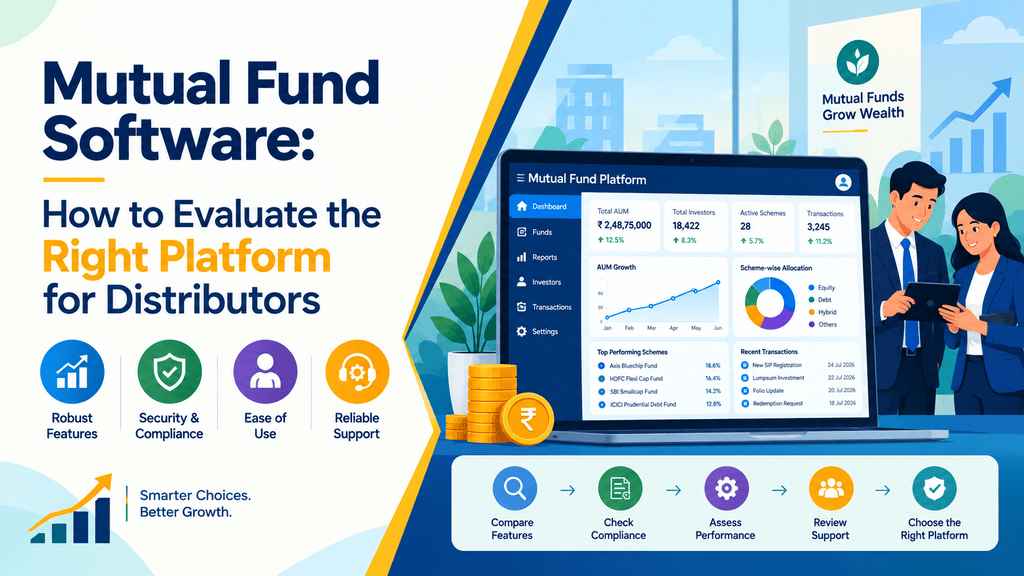
Mutual fund distribution has changed dramatically over the past decade. What used to run on paper application forms, manual reconciliation, and disconnected spreadsheets is now expected to run as a fully digital, multi-channel business — one where customers onboard themselves online, RMs manage portfolios from a dashboard, and revenue reconciliation happens automatically instead of at month-end panic. For banks and financial institutions looking to scale their mutual fund distribution business, choosing the right Mutual Fund Software isn’t a minor IT decision — it directly determines how efficiently the business runs and how much revenue leakage gets caught before it becomes a problem. Here’s what actually matters when evaluating a platform, based on what a comprehensive solution needs to deliver.
Start With the Core Business Problem It Solves
Before comparing feature lists, it’s worth being clear about what mutual fund software is actually meant to fix. Banks and financial institutions are automating their mutual fund distribution to scale the business with ease, accuracy, and reduced total cost of ownership (TCO). The shift is from costly paper trails to digitized customer onboarding — meaning the platform you choose should fundamentally change how customers get onboarded, not just digitize the same manual process. If a platform still requires physical forms, manual verification, or offline risk profiling, it isn’t solving the core problem distributors actually have.
Evaluate Whether It Covers the Full Business, Not Just One Function
A common mistake distributors make is evaluating mutual fund software purely on its customer-facing features. But a platform built for serious scale — the kind used by leading mutual fund distributors in India — needs to function across the entire business, not just the sales end. This means looking for a platform that offers:
- A Back Office for managing operations at the central office level
- A Sales/RM interface to facilitate branch-level operations
- A Customer interface for direct client interaction
When these three layers are properly integrated — rather than bolted together as separate systems — data flows consistently between them, which is what actually reduces operational overhead rather than just shifting the paperwork problem from physical to digital.
Check the Customer Portal Against Real Digital Expectations
The customer-facing layer is where most distributors focus first, and rightly so — it’s what determines whether customers actually adopt the digital channel instead of falling back on RM-assisted paper processes. A strong customer portal should offer:
- Instant digital onboarding with eKYC and risk profiling — not a multi-day manual verification process
- A comprehensive portfolio dashboard, giving customers real visibility into their holdings
- Instant digital goal planning and tracking, so customers can map investments to actual financial objectives
- Digital transaction execution for both lumpsum and systematic investments, since most mutual fund business runs on a mix of one-time and recurring transactions
- Performance analytics and alerts, keeping customers informed without requiring them to log in constantly
- Digital non-financial transaction execution, covering the administrative changes customers need to make outside of buying and selling
- Support for handheld devices and responsive design, since a growing share of investment activity happens on mobile
- Call center-assisted transaction execution, for customers who still prefer human assistance
- A cart facility, allowing customers to build and execute multi-scheme transactions in one flow
If a platform is missing several of these, it’s likely to push more transaction volume back onto RMs manually — defeating the purpose of digitization in the first place.
Assess the Advisor/RM Portal Just as Carefully
Distributors sometimes underweight the RM-facing side of the platform, but this is where day-to-day business actually gets managed at scale. A platform worth evaluating seriously should give RMs:
- A comprehensive RM/advisor dashboard
- Full customer portfolio visibility with analytics, not just raw transaction data
- Comprehensive RM/advisor reports, supporting performance tracking and client reviews
- RM-assisted customer onboarding and re-risk profiling, for the customers who still need human guidance
- RM-assisted transaction execution
- RM-assisted scheduling of reports and alerts
- Prospect and campaign management, supporting business development, not just servicing
- RM targets and incentive management, tying the platform directly into how the distribution business actually motivates its sales force
This is a meaningful differentiator: platforms that treat RMs as an afterthought tend to force advisors into workarounds, which erodes both productivity and data accuracy over time.
Look Closely at the Operations Layer — This Is Where Revenue Leakage Happens
If there’s one area that separates genuinely enterprise-grade mutual fund software from a basic digital front end, it’s the operations layer. This is where revenue accuracy, reconciliation, and system integration actually get handled, and it should include:
- Integration with various data service providers
- Integration with existing core systems, so the mutual fund platform doesn’t operate as an isolated silo
- Rule-based revenue calculation covering upfront, annualized, trail, incentive, and claw-back structures — mutual fund revenue models are genuinely complex, and a platform that can’t handle all of these accurately will produce revenue disputes
- Automated revenue reconciliation, which is critical: accurate, software-driven reconciliation of income calculation with RTA data means distributors can plug revenue leakage that would otherwise go unnoticed in manual processes
- Seamless order processing via interfacing with RTA and BSE Star
- Customer portfolio returns calculation
- RTA interface for reverse feeds covering transactions, NAV, and income data
- A comprehensive, customizable reporting module
- Integration with a Document Management System
When evaluating platforms, this is the layer worth stress-testing the hardest — because errors here directly translate to lost revenue, not just operational inconvenience.
Don’t Overlook Business MIS Reporting
Beyond day-to-day operations, distributors need visibility into how the business is actually performing. The right platform should provide Business MIS covering:
- Assets Under Management (AUM) reports
- Mobilization reports
- Income reports
- Active systematic (SIP) reports
- YTD and MTD business reports
- Zone-wise business reports
Without this level of reporting, distributors are left making business decisions on incomplete data — which becomes a bigger problem as the distribution business scales across more branches, zones, or advisor teams.
Practical Evaluation Criteria to Apply
Pulling this together, here’s what to actually check when comparing mutual fund software options:
- Does it eliminate paper-based onboarding entirely, or just digitize part of the process?
- Does it support multiple digital channels — customer portal, handheld devices, call center, and RM-assisted — so customers can transact however they prefer?
- Does the operations layer handle rule-based revenue calculation across all common structures (upfront, trail, incentive, claw-back)?
- Is revenue reconciliation automated against RTA data, or does it still require manual matching?
- Does it integrate with your existing core systems, or would it operate as a disconnected add-on?
- Is it proven at scale — used by leading distributors, and implemented across global banks and financial institutions?
- Is it built to extend, with scalable, extensible functionality as the business grows, rather than requiring a platform switch later?
Why This Matters Beyond Mutual Fund Distribution
A platform like SmartMutual is one part of a broader wealth management ecosystem, and it’s worth evaluating mutual fund software with that bigger picture in mind. The same platform philosophy — integrated back office, advisor tools, and automated reconciliation — extends across Winsoft’s Wealth Management Platform, which supports end-to-end management of financial asset classes beyond just mutual funds. For distributors managing multiple product lines, evaluating how well a mutual fund platform fits into (or connects with) this wider ecosystem is just as important as evaluating its standalone features.
Implementing a platform of this depth — with integrations spanning core banking systems, RTAs, exchanges, and data service providers — also typically requires dedicated technical capacity during rollout. Many distributors turn to IT Staff Augmentation to support implementation and integration phases without committing to long-term hires solely for a rollout period. And because a platform this central to the business often anchors a wider modernization effort, mutual fund software evaluations frequently happen alongside broader Digital Transformation Services initiatives, rather than as an isolated technology purchase.
Conclusion
Evaluating mutual fund software properly means looking well beyond the customer-facing app. The right platform for distributors needs to work across four layers — customer portal, advisor/RM portal, operations, and business MIS — with genuine integration between them, accurate rule-based revenue calculation, and automated reconciliation that catches revenue leakage before it becomes a recurring loss. Distributors who evaluate platforms against this full picture, rather than just the sales-facing interface, are far more likely to choose a system that scales with the business instead of becoming another operational bottleneck.