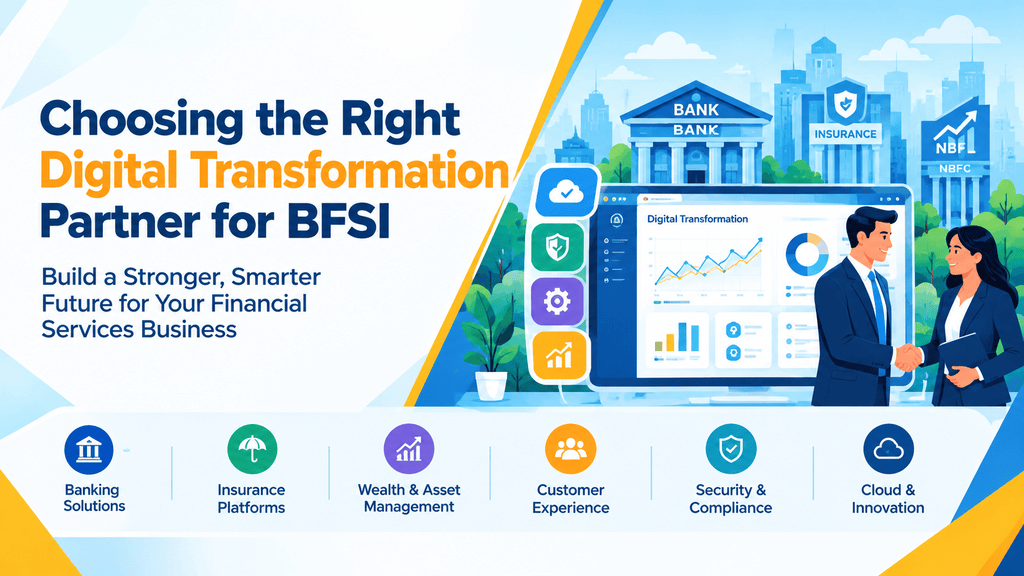
Every bank, insurer, pension distributor, and wealth management firm today is under pressure to modernize. Customers expect faster onboarding, seamless digital journeys, and the same quality of experience they get from the best consumer apps. But digital transformation in financial services is not a product you buy off a shelf. It is a long-term change in how an institution operates, and the partner you choose will shape how well that change goes.
The wrong choice leads to stalled projects, technology that does not fit your operating model, and a customer experience that barely improves. The right one helps you see the gaps in your strategy and close them with confidence. This guide walks through what to look for, and what to ask, before you commit.
Why the Choice of Partner Matters More in BFSI
Financial institutions deal with sensitive data, strict regulation, and systems built up over many years. A transformation partner therefore has to understand two worlds at once: the digital side and the industry side.
Winsoft describes its own approach as helping clients create exceptional customer experiences using analytics, automation and cloud, with the right mix of digital and industry experience. That pairing is a useful benchmark when you assess any partner. A team strong only in technology tends to leave the industry context for you to explain, while a team strong only in industry knowledge may struggle to deliver modern digital solutions.
Start With the Customer Experience Goal
Before you compare vendors, decide what “better” actually means for your customers. Is it faster account or policy onboarding? Fewer branch visits? Simpler renewals? A clear goal gives you a way to judge every proposal you receive.
The aim of good digital transformation is to meet and beat customer expectations. A strong partner starts from that outcome and works backward to the technology, using suitable digital transformation technologies to revamp the customer experience. Be cautious of partners who start with a favorite tool and then look for a problem it can solve.
Look for a Partner That Identifies Strategy Gaps First
One of the most valuable things digital transformation in financial services can do is help companies identify the gaps in their strategy. That only happens if the partner begins with assessment rather than a sales pitch.
Ask how the engagement starts. Will the partner review where you are today, point out where your strategy and your customer experience fall short, and give you key insights to drive your digital strategy? If a proposal jumps straight to implementation without examining your current position, you may end up building the wrong thing very efficiently.
Check Their Approach to Open Technologies
A good partner invests in the best open technologies rather than locking you into a closed approach. This matters for BFSI because your new digital layer has to work alongside what you already run, including core banking and other back-office systems.
Ask which technologies the partner recommends and why. Ask how they integrate with your existing platforms, and how easy it will be to adapt later as your needs change. Partners who already build and support Banking Technology Solutions tend to understand these integration realities well, because they work with banking systems every day.
Make Sure the Framework Fits Your Operating Model
Every institution runs differently. A bank’s approval flows, an insurance distributor’s agent network, and a pension intermediary’s subscriber processes all have their own logic. A one-size-fits-all template rarely works across them.
The better approach is for consultants to develop the right framework by understanding your operating model and matching it with the best practices of the industry. During evaluation, ask the partner how they will learn how your organization works. Do they plan workshops with your teams? Do they study your current processes? The answers show whether they intend to fit the solution to you or fit you to the solution.
Evaluate Their Strength in Analytics, Automation, and Cloud
These three capabilities sit at the center of modern customer experience, so a partner should be able to speak confidently about each one.
- Analytics turns data into insights that guide decisions about products, customers, and service quality.
- Automation reduces manual effort in repetitive processes, which speeds up service and lowers the chance of errors.
- Cloud gives you room to scale and adapt without being tied down by rigid infrastructure.
Rather than treating these as separate add-ons, ask how the partner combines them in one connected solution. A customer journey that uses automation without analytics, or cloud without a clear process behind it, rarely delivers the full benefit.
Industry Experience Is as Important as Digital Skill
Digital skill alone is not enough in a regulated industry. Your partner should know how banking, insurance, pension, and wealth operations actually work, including their compliance needs and their day-to-day pressure points.
Winsoft was founded in 1993 and has built specialized software products and services for the BFSI industry, serving blue-chip organizations. Its product range spans banking and capital markets, insurance, pension, and wealth management. A partner that builds products such as Insurance Distribution Software understands how distribution workflows run in practice, and that practical knowledge shows up in better transformation advice.
Check Delivery Depth and Long-Term Support
A strategy is only valuable if it is delivered well and kept running afterward. Look at what the partner can do beyond the initial project: testing, turn-key delivery, product re-engineering, and ongoing support.
Winsoft points to 25+ years of expertise in managing a customer’s application life-cycle, along with testing services focused on robust and reliable software. Those are the kinds of capabilities that matter once a project moves from planning to live operations. Transformation programs also tend to need extra technical capacity at certain stages, such as integration and testing. A partner who can provide IT Staff Augmentation for both short-term and long-term needs can help you add skilled people without slowing the program down.
Questions Worth Asking Every Shortlisted Partner
Use this checklist when you speak with potential partners:
- How will you assess our current strategy and identify gaps before proposing solutions?
- Which open technologies do you recommend, and how will they integrate with our existing systems?
- How will you learn our operating model and shape the framework around it?
- How do analytics, automation, and cloud work together in your approach?
- What BFSI experience do you have in our specific segment: banking, insurance, pension, or wealth?
- What support do you offer after go-live, including testing and re-engineering?
- Can you add technical resources quickly if the program needs them?
Clear, specific answers to these questions are a good sign. Vague or purely sales-driven answers are worth noting.
Final Thoughts
Choosing a digital transformation partner is really choosing how your institution will meet rising customer expectations over the coming years. The strongest partners combine digital and industry experience, begin by identifying gaps in your strategy, favor open technologies, build a framework around your operating model, and stay with you through delivery and beyond.
Take your time with the evaluation, ask the hard questions, and pick the partner who understands both your customers and your business. To see how this approach works in practice, explore Winsoft’s Digital Transformation Services and speak with the team about your goals.