Ask a bank leader what their technology stack looks like, and you will often hear two terms used almost interchangeably: core banking and digital banking. They are not the same thing, and mixing them up leads to poor planning. A bank may have a strong core system and still offer customers a slow, paper-heavy experience. Another may launch an attractive digital channel that struggles because it does not connect properly to what sits behind it.
Understanding how the two relate is one of the most practical things a bank can do before investing in new technology. This guide explains the difference in plain terms, shows how they work together, and outlines what banks should look for in Digital Banking Solutions.
The Short Version of the Difference
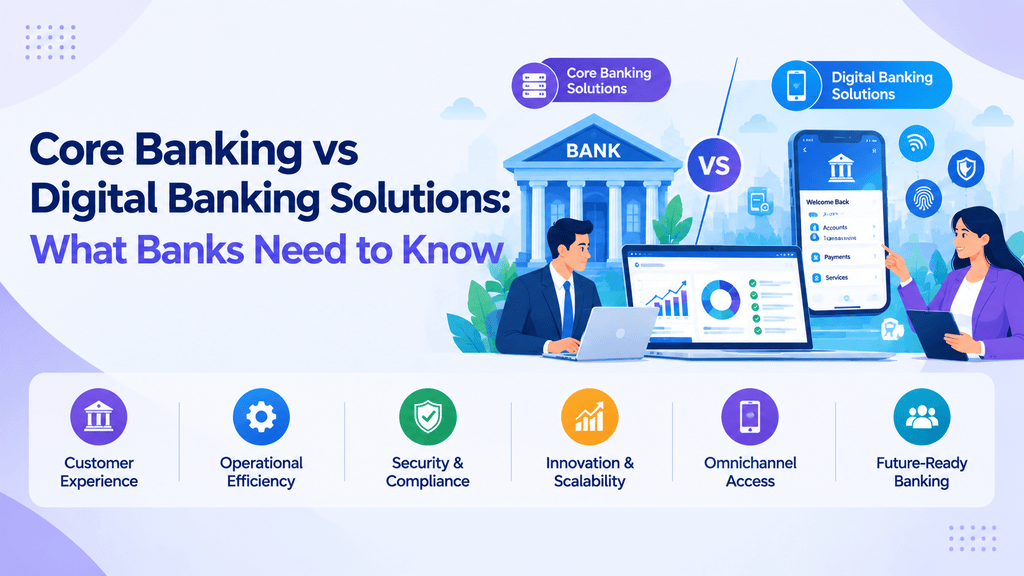
Think of the core banking system as the foundation of the bank. It is where critical actions such as lien marking, lien removal, and fund transfer are carried out. Systems like Finacle, FlexCube, and T24 are examples that appear across Winsoft’s product pages as the systems its solutions connect to.
Digital banking solutions sit around that foundation. They are the applications that handle specific business activities, serve customers and staff, and connect to the core when money or records need to move. As global trends change, banks are moving to digitized solutions to cater to their clients’ needs, and these solutions are how that move happens in practice.
The key point is that one does not replace the other. A bank needs both, and the quality of the connection between them often decides how good the customer experience feels.
Where Digital Solutions Add Value on Top of the Core
The clearest way to see the difference is through examples of what digital solutions actually do. Winsoft’s banking and capital market suite offers several.
IPO and primary market processing. Smart ASBA is a complete IPO application processing platform for financial distributors, covering IPO, FPO, DEBT/NCD, NFO, and Right Issue products. It lets a bank process high volume IPO applications right up to the final allotment of shares. To do this, it integrates with core banking systems like Finacle and FlexCube for lien marking, lien removal, and fund transfer. The digital layer manages applications, while the core handles the funds. Banks looking at this area in detail can learn more about IPO Application Software and how it fits into daily operations.
Depository services. DeMATrix is a comprehensive software solution for both CDSL and NSDL depository participants. It is web-based and handles 1 Lakh+ DP transactions per day. This is a specialized activity that benefits from a dedicated application rather than being forced into a general-purpose system.
Locker management. SmartLocker is a locker management solution that simplifies end-to-end operations for banks and their customers. It covers locker requests, allocations, access, key issuance, blocking and unblocking, and rent payments.
Tax payments. Smart Tax is a full-fledged direct and indirect tax payment solution that helps banks process online and digital tax payments.
Sales tracking. Smart Sell is an application for B2B engagement strategy execution, working as an opportunity tracking platform so that sales teams work more efficiently.
Cash operations. Winsoft also offers a dynamic solution for banks to manage cash pickup and delivery, helping them handle collection and delivery operations efficiently.
Each of these addresses a specific business need. None of them replaces the core. They extend what the bank can do and improve how quickly and smoothly it can do it.
Why the Connection Between the Two Matters
A digital solution is only as useful as its link to the core. If the two do not talk to each other, staff end up re-entering information, reconciling mismatches, and chasing errors.
Winsoft’s solutions reflect this in how they are built. eFDR is a clear example. Financial institutions must hold fixed deposit collateral with banks, certified by NSE, before they can participate in the equity market. All FDs issued or matured by banks must be informed to NSE through the NSE API stack. eFDR consumes that API stack and gives bank users a front end to notify NSE once collateral deposit funds are placed with the bank and line marked in T24. Here the digital layer does the communication, while the core records the underlying position.
This pattern repeats across the suite. Whether the task is an IPO application, a pension contribution, or a government insurance scheme enrollment, the digital solution takes care of the process and hands off to the core for fund movement through integration.
What Banks Should Ask Before Choosing a Digital Solution
Because the connection matters so much, banks should evaluate it directly. Use these questions:
- Which core banking systems does the solution integrate with? Ask for named systems and real examples.
- What actions does it perform in the core? For instance, lien marking, lien removal, and fund transfer.
- How is the integration built? API-based connections are generally easier to maintain and extend.
- Does it handle volume? Look for clear figures, such as the 1 Lakh+ daily DP transactions DeMATrix is built to manage.
- Does it serve a specific business need well? Specialized tools often outperform generic ones for focused activities.
- How are reports and audit needs met? Banks need dependable records of what happened and when.
Clear answers to these questions reveal whether a solution will work smoothly in your environment or create extra work.
A Focus on Financial Product Distribution
One more point is worth noting. Winsoft specializes in software applications for financial product distribution, and its primary advantage lies in extensive domain knowledge and a specialized team working on the latest technology. This matters because banks increasingly distribute products such as IPOs, mutual funds, insurance, and pension schemes through their branches and digital channels.
The more products a bank distributes, the more important it becomes to have digital solutions built for each activity, connected to the core and consistent across channels. This is where a bank’s ability to add value to its customers grows, which in turn strengthens its business.
Planning the Move: Core and Digital Together
Banks sometimes treat core and digital as two separate projects, run by different teams on different timelines. That approach often causes friction later. A better path is to plan both together, so that each new digital solution is chosen with its core connection in mind.
Many banks do this as part of a larger modernization program. Working with Digital Transformation Services helps align customer experience goals, technology choices, and operating models so that the pieces fit together instead of competing.
Rollouts like this also require skilled people for integration and testing. Banks often bring in IT Staff Augmentation to add technical capacity for the period they need it, without committing to permanent hires.
Common Mistakes to Avoid
- Treating digital as a cosmetic layer. A new app on top of weak connections to the core will not fix operational problems.
- Ignoring integration until late. Raise it at the start of vendor discussions, not at the end.
- Choosing generic tools for specialized work. Activities like depository services or IPO processing benefit from purpose-built solutions.
- Overlooking volume. A tool that works in a pilot may struggle at full scale, so ask about proven volumes.
- Planning in silos. Core and digital teams should work from a shared roadmap.
Final Thoughts
Core banking and digital banking solutions are partners, not competitors. The core is where critical banking actions are carried out, and digital solutions are the applications that make specific services faster, simpler, and better for customers and staff. What separates a smooth banking experience from a frustrating one is usually the quality of the connection between them.
Banks that understand this relationship can choose their technology with confidence. They ask better questions, plan core and digital together, and pick solutions built for the specific work they need done. That clarity is what turns technology spending into real improvement for customers.