Customers no longer compare their bank only with other banks. They compare it with every app and service they use in daily life. If ordering food takes two taps, they wonder why opening an account or applying for an IPO should take a branch visit and a stack of forms.
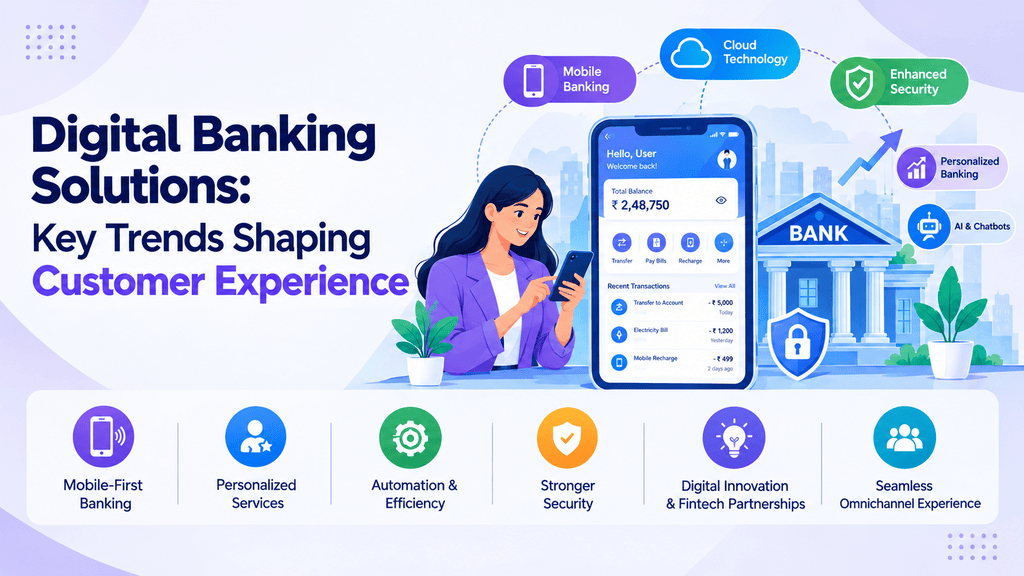
That expectation is changing how banks think about technology. As global trends shift, banks are moving to digitized solutions to meet their clients’ needs. This guide looks at the key shifts shaping customer experience today and what they mean for banks investing in Digital Banking Solutions. Each trend below is grounded in how digital solutions are actually being built and used for banks and capital markets.
Trend 1: Customers Expect Many Ways to Reach the Bank
The first shift is simple: customers want choice. Some prefer their phone, some use internet banking, some still like to walk into a branch, and many deal through advisors or partners.
Banks are responding by offering multiple digital channels for the same service. In IPO and primary market applications, for example, investors can invest through internet banking, handheld devices, and channel partners, with every channel feeding into the same processing platform. SmartASBA’s ASBA On-Net module supports this with API-based interfaces for mobile and seamless integration with the retail banking portal.
The same pattern appears in pension and mutual fund services, where subscribers and investors can transact through a portal, mobile device, branch, or relationship manager. The lesson for banks is that customer experience is not about one perfect channel. It is about giving every channel the same quality of service.
Trend 2: Onboarding Is Moving From Paper to Digital
The first impression a customer has of a bank is usually the onboarding process. Long forms, repeated verification, and slow turnaround leave customers frustrated before they have even started.
Digital onboarding is changing this. Winsoft’s pension and mutual fund platforms offer instant digital onboarding with KYC and eKYC, replacing costly paper trails with a digitized process. In pension, this makes PRAN generation faster and lets subscribers begin investing on the fly. In mutual funds, it comes with risk profiling built into the same journey.
For banks, faster onboarding means customers reach their first transaction sooner, and staff spend less time on paperwork.
Trend 3: Everyday Services Are Becoming Self-Service
Not every banking service is a headline product. Some of the most common customer frustrations come from routine tasks: asking for a locker, paying a tax, or waiting for a status update.
Digital solutions are turning these into smoother experiences:
- Locker services. SmartLocker simplifies end-to-end locker operations for banks and customers, covering locker requests, allocations, access, key issuance, blocking and unblocking, and rent payments.
- Tax payments. Smart Tax is a full-fledged direct and indirect tax payment solution that helps banks process online and digital tax payments.
When routine services move into well-designed digital processes, customers spend less time waiting and more time doing what they came to do. Staff are also freed from repetitive handling.
Trend 4: High-Volume Processing Is Being Automated
Behind every smooth customer experience is heavy processing that customers never see. Peak events, such as a popular IPO, can bring huge numbers of applications in a short window. If processing cannot keep up, customers feel the delay directly.
Automation is how banks handle this. SmartASBA enables a bank to process high-volume IPO applications right up to the final allotment of shares, and it supports bulk upload of application forms. DeMATrix, a web-based solution for both CDSL and NSDL depository participants, handles 1 Lakh+ DP transactions per day.
The customer-facing result is reliability. When the system keeps pace with demand, customers get timely confirmations and fewer errors.
Trend 5: Integration Is Making Services Feel Seamless
Customers rarely know or care how many systems sit behind a single request. They only notice when something is slow, repeated, or inconsistent. Strong integration is what hides that complexity.
Winsoft’s solutions are built to connect with the systems banks already run. SmartASBA integrates with core banking systems such as Finacle and FlexCube for lien marking, lien removal, and fund transfer, and with SMS and email gateways and online PAN verification. eFDR consumes the NSE API stack so that banks can notify NSE about fixed deposit collateral without manual coordination.
When systems exchange information automatically, customers do not have to repeat themselves, and staff do not have to chase data between screens.
Trend 6: Real-Time Visibility and Proactive Alerts
Customers increasingly expect to know where their request stands without calling the bank. Banks, in turn, need to see the same picture internally.
Digital solutions respond with dashboards and alerts. SmartASBA provides a single-click dashboard to monitor the process from application registration to allotment, along with SMS and email alerts. Pension processing includes one-view status tracking for requests received from branches, internet, and mobile.
This visibility reduces anxious follow-up calls and gives managers early warning when something needs attention.
Trend 7: Customer-Centric Design Backed by Security and Compliance
A good digital experience has to be safe as well as easy. Winsoft describes its approach as spanning secure and compliant ecosystems on one end and customer-centric interfaces on the other. Both matter equally in banking.
This shows up in practical features such as maker and checker controls, granular user access control, and compliance reports for regulators including SEBI, NSE, and BSE. Customers may never see these controls, but they depend on them every time they trust the bank with their money or data.
Trend 8: Specialization in Financial Product Distribution
Banks today distribute far more than accounts and loans. IPOs, mutual funds, insurance, and pension schemes all pass through branches and digital channels. Each has its own rules and workflows, and generic tools often struggle to handle them well.
That is why specialization matters. Winsoft focuses on software applications for financial product distribution, backed by extensive domain knowledge and a specialized team working on the latest technology. Customers benefit when each product is served by a platform designed for it. Pension subscribers, for example, get a workflow built around NPS needs through National Pension Scheme Software, while investors in funds are served by dedicated Mutual Fund Software.
What These Trends Mean for Banks
Taken together, the trends point to a clear message. Better customer experience is built from many connected parts: more channels, faster onboarding, self-service, automation, integration, visibility, safety, and specialization. Weakness in any one of them tends to show up in the customer’s experience.
When reviewing your own digital plans, ask:
- Can customers use the channel they prefer, and does each channel offer the same quality?
- How quickly can a new customer be onboarded without paper?
- Which routine services still need a branch visit that could be digitized?
- Can our systems handle peak volumes without delays?
- Do our digital solutions connect to the core and to external systems automatically?
- Can customers and staff see the status of a request at any time?
- Are security and compliance built in rather than added later?
Turning Trends Into a Plan
Understanding trends is easy. Acting on them takes coordination. Many banks treat this as part of a broader program of Digital Transformation Services, which aligns customer experience goals with technology choices and the way the bank operates. Doing so keeps individual projects from drifting apart and helps customers see a consistent experience across products.
Final Thoughts
Customer experience in banking is being reshaped by a handful of practical shifts. Customers want choice of channels, quick digital onboarding, simple self-service, reliable processing, seamless connections between systems, clear visibility, and the reassurance of security. Banks that build their digital banking solutions around these shifts give customers a reason to stay, and give their own teams a smoother way to work.
The banks that benefit most will be those that treat digital not as a single project but as a steady, connected effort across every product and channel they offer.