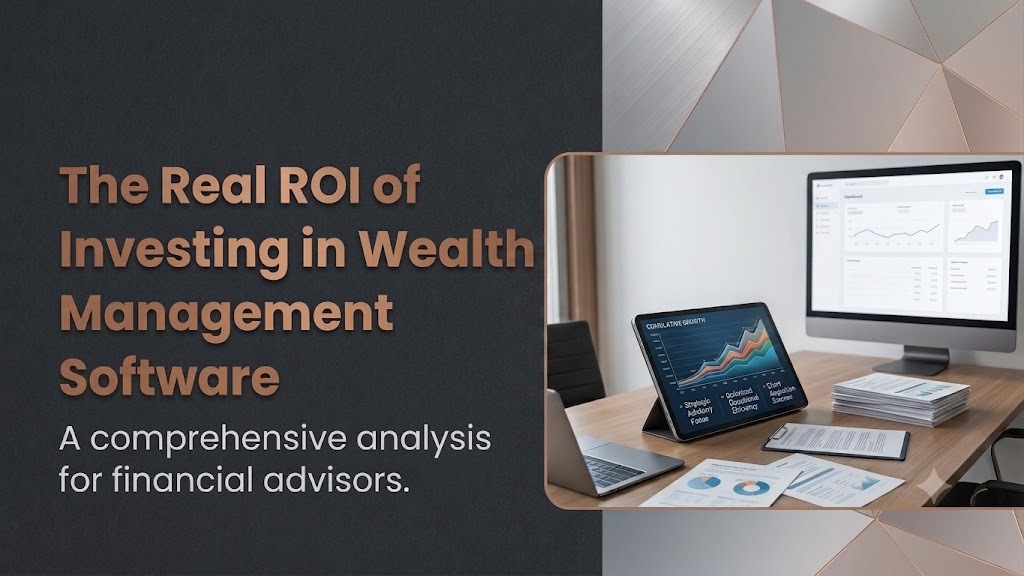
When financial institutions think about technology investments, the first question that comes up is almost always the same: is it worth the cost? For wealth management firms, this question carries extra weight because the software isn’t just a back-office tool, it directly touches client relationships, portfolio performance, and regulatory standing.
Let’s move beyond the sales pitch and look honestly at where the real returns come from when firms invest in the right technology.
Why “ROI” Means More Than Cost Savings Here
Return on investment is often measured purely in rupees saved. But in wealth management, the returns show up in several different forms, some financial, some operational, and some reputational.
Before diving into numbers, it helps to ask: what are firms actually trying to achieve when they adopt new platforms?
- Reducing time spent on manual, repetitive tasks
- Improving accuracy in portfolio reporting and compliance
- Delivering a better, more personalised client experience
- Growing your business and managing more clients without having to hire more staff
- Staying competitive as client expectations shift toward digital-first service
With that context, the ROI conversation becomes much broader than a simple cost-benefit spreadsheet.
1. Time Savings That Translate Directly Into Capacity
One of the most immediate returns comes from time. Relationship managers and advisors who previously spent hours compiling portfolio reports or reconciling data across spreadsheets can now access this information instantly through a centralised system.
Wealth Management Software consolidates client portfolios, transaction histories, and performance data into a single view, cutting down the manual effort that used to eat into client-facing time. When advisors spend less time on data entry and more time on advisory conversations, the firm’s overall capacity effectively increases without adding new staff.
How Much Time Are We Really Talking About?
While exact figures vary by firm size and existing processes, the pattern is consistent: tasks that once took hours, such as generating consolidated portfolio statements, can often be completed in minutes once automated. This time reclaims itself in the form of more client interactions, faster turnaround on queries, and reduced backlog during busy periods.
2. Fewer Errors, Lower Compliance Risk
Manual processes are inherently prone to human error, and in wealth management, even small errors in reporting or compliance documentation can lead to significant consequences.
Automated systems reduce this risk by:
- Standardising data entry and calculations
- Flagging inconsistencies before they become bigger issues
- Maintaining audit-ready records automatically
- Applying compliance rules consistently across client accounts
This reduction in error rates isn’t always visible on a balance sheet immediately, but the avoided costs of regulatory penalties, client disputes, or reputational damage represent a meaningful, if less obvious, form of ROI.
3. Better Client Experience, Better Retention
Client expectations have shifted considerably. Investors today expect real-time access to their portfolio performance, transparent reporting, and quick responses to their queries.
Firms that invest in the right platforms are better positioned to meet these expectations. Features like real-time dashboards, automated alerts, and self-service portals give clients more visibility and control, which in turn builds trust and long-term loyalty.
Retained clients are, of course, far more valuable than newly acquired ones when you factor in acquisition costs, making client retention one of the more underrated returns on this kind of investment.
4. Dedicated Automation for Mutual Funds and Specialized Investments
Different financial products come with their own unique operational rules. A one-size-fits-all wealth platform often falls short when managing the specific needs of mutual funds, PMS, or gold bonds.
This is where purpose-built software makes a real difference. Dedicated systems automate product-specific tasks such as daily NAV updates, SIP tracking, order routing, redemption processing, and brokerage reconciliation. By using Mutual Fund Software built specifically for these workflows, firms avoid risky manual workarounds and keep their operations running smoothly without errors.
Is Building In-House Always the Right Approach?
A common question firms face is whether to build these systems internally or rely on external expertise. Building and maintaining wealth management technology in-house requires specialised skills that many firms don’t have readily available, and hiring full-time for every requirement isn’t always practical.
This is where Software Staff Augmentation becomes a valuable option. It allows firms to bring in skilled technology professionals on a flexible basis, whether for initial development, ongoing maintenance, or scaling up during periods of high demand, without the long-term overhead of expanding permanent headcount.
5. Scalability Without Proportional Cost Increases
As firms grow their client base, manual processes typically require proportional increases in staff to keep up. Technology changes this equation.
A well-implemented system can handle significantly more clients, transactions, and reporting requirements without a corresponding jump in operational costs. This scalability is often where the long-term ROI becomes most apparent, particularly for firms experiencing steady growth.
Measuring ROI: What Should Firms Actually Track?
To get a realistic picture of returns, firms should look at metrics such as:
- Time saved per advisor on reporting and administrative tasks
- Reduction in compliance-related errors or flagged issues
- Client retention and satisfaction scores over time
- Faster growth in client investments (AUM) compared to team size
- Speed of onboarding new clients or products
Tracking these metrics over a defined period gives a clearer, more grounded picture of value than looking at cost savings alone.
Setting Realistic Expectations
It’s worth noting that ROI from these investments doesn’t materialise overnight. Implementation, staff training, and process adjustments all take time. Firms that see the most meaningful returns are typically those that approach the transition with a clear plan, realistic timelines, and ongoing evaluation rather than expecting immediate transformation.
Conclusion
The real ROI of investing in Wealth Management Software isn’t captured in a single number. It shows up gradually, through time saved, errors avoided, clients retained, and operations scaled more efficiently. Firms that look beyond upfront costs and evaluate these broader, longer-term returns are better positioned to make technology decisions that genuinely strengthen their business over time.
FAQs
Q1. How long does it typically take to see ROI from wealth management software?
This varies by firm, but most organisations begin seeing operational benefits, such as time savings, within the first few months, while broader financial returns often become clearer over a year or more.
Q2. Does wealth management software only benefit large firms?
No, firms of various sizes can benefit, particularly smaller firms looking to scale operations without significantly increasing headcount.
Q3. What’s the difference between wealth management software and mutual fund software?
Wealth management software typically covers broader portfolio and client management functions, while mutual fund software focuses specifically on fund tracking, NAV updates, and related processes.
Q4. Why would a firm consider staff augmentation instead of hiring full-time?
It offers flexibility to access specialised skills for specific projects or periods of growth without the long-term commitment of permanent hires.
Q5. What metrics best reflect the ROI of this kind of technology investment?
Time saved on manual tasks, reduction in compliance errors, client retention rates, and scalability of operations relative to headcount are all useful indicators.