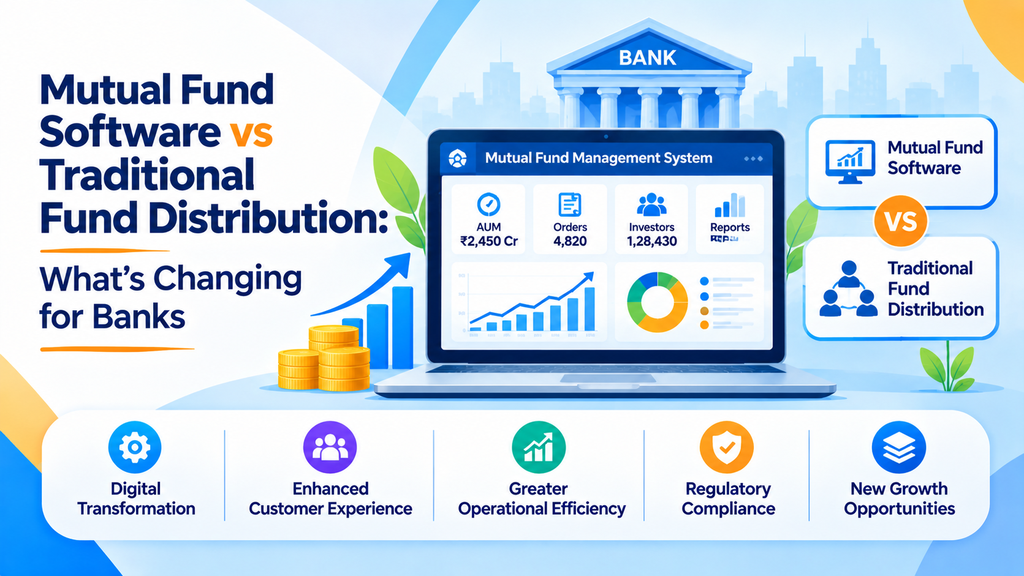
For years, selling mutual funds through a bank branch followed a familiar pattern. A customer visited, filled in forms, waited for verification, and received updates by post or phone. Relationship managers (RMs) kept track of clients through files, spreadsheets, and memory. Income was calculated at the end of the month, often by hand, and mismatches were chased down later.
That pattern is changing. Customers now expect to invest from their phones, see their portfolios at any time, and get quick answers. Banks, in turn, need accuracy and efficiency to make the business worthwhile. This guide compares traditional fund distribution with modern Mutual Fund Software for Banks and explains what is changing, why it matters, and what banks should think about as they plan their next steps.
How Traditional Fund Distribution Usually Works
Traditional distribution relies heavily on people and paper. While every bank has its own way of working, a few features are common:
- Paper-based onboarding. Customers complete physical forms, and staff handle verification and record keeping manually.
- Branch-centered transactions. Most investment activity needs a visit or a call to an RM.
- Scattered records. Client information may sit in different files and systems, which makes a complete view difficult.
- Manual income calculation. Revenue from different schemes and structures is worked out by hand or with basic tools.
- Delayed reporting. Management reports take time to assemble, so decisions are made on older information.
None of this means traditional methods never worked. They worked at a smaller scale. The difficulty is that as the business grows, each of these manual steps becomes a source of delay, error, and cost.
What Modern Mutual Fund Software Changes
Modern platforms address these weaknesses directly. On the SmartMutual page, the purpose is described as the digitization of the mutual fund business so that financial distributors can manage, grow, and service their clients. Banks and financial institutions are automating to scale the business with ease, accuracy, and reduced total cost of ownership (TCO).
Here is how the main parts of the business change.
From Paper Trails to Digital Onboarding
Onboarding is where the difference is most visible. Customer onboarding is moving from costly paper trails to a digitized solution. In SmartMutual, customers can be onboarded instantly with eKYC and risk profiling, so the first step of the relationship no longer depends on physical forms.
For the bank, this means fewer documents to store and verify. For the customer, it means starting to invest sooner.
From One Channel to Many
In the traditional model, the branch is the main point of contact. Modern platforms support several channels at once. Customers can invest through a customer portal, handheld devices, a call center, or RM-assisted channels.
This matters because customers differ. Some prefer to transact on their own, others like to speak to someone first. A platform that supports both lets the bank serve each customer in the way they prefer, without maintaining separate processes.
From Scattered Records to a Clear Portfolio View
Customers using the portal get a comprehensive portfolio dashboard, instant digital goal planning and tracking, and performance analytics and alerts. They can carry out digital transactions, including lumpsum and systematic ones, and non-financial requests as well. A cart facility also lets them build and execute transactions in one flow.
Advisors get their own view. The Advisor/RM portal offers a comprehensive dashboard, a full customer portfolio with analytics, and reports. This replaces the effort of piecing together client information from different places.
From Reactive Selling to Managed Campaigns
Traditional distribution often depends on an RM remembering whom to call. Modern platforms support prospect and campaign management, RM targets, and incentive management. RMs can also assist customers with onboarding, re-risk profiling, and transactions, and schedule reports and alerts. This gives sales teams structure, and gives managers visibility into what is working.
From Manual Income Calculation to Automated Reconciliation
This is where the financial impact can be largest. Revenue in mutual fund distribution comes in several forms. SmartMutual’s operations portal offers rule-based revenue calculation covering upfront, annualized, trail, incentive, and claw-back, along with an automated revenue reconciliation process.
The page notes that accurate, software-driven reconciliation of income calculation with RTA data means distributors can plug revenue leakage. In a manual setup, small mismatches can go unnoticed for long periods. Automation catches them earlier, which protects the bank’s income.
From Delayed Reports to Ready Dashboards
Business MIS reports and dashboards help advisors enhance productivity. The reporting range includes Assets Under Management reports, mobilization reports, income reports, active systematic reports, YTD and MTD business reports, and zone-wise business reports. Managers no longer need to wait for reports to be assembled before reviewing performance.
Side-by-Side Comparison
| Area | Traditional distribution | Modern mutual fund software |
| Onboarding | Paper forms and manual checks | Digital onboarding with eKYC and risk profiling |
| Channels | Mainly branch and phone | Portal, handheld devices, call center, RM-assisted |
| Client records | Spread across files | Portfolio dashboards for customers and RMs |
| Income calculation | Manual, often at month-end | Rule-based calculation across revenue types |
| Reconciliation | Manual matching | Automated, against RTA data |
| Reporting | Assembled on request | MIS reports and dashboards |
| Sales management | Individual RM effort | Campaigns, targets, and incentive tracking |
Why Banks Are Making the Shift
Several practical reasons push banks toward modern platforms:
- Scale. A manual process that works for a few hundred customers struggles with thousands.
- Accuracy. Automated calculation and reconciliation reduce errors and protect revenue.
- Cost. Reduced TCO is a stated goal of automation, since less manual effort is needed for each transaction.
- Customer expectations. Customers increasingly expect digital access to their investments.
- Advisor productivity. Time freed from paperwork can be spent on relationships. The page lists “frees up time to invest in relationships” among the benefits.
- Revenue opportunity. Easier cross-selling and up-selling can create more chances to generate revenue.
The page also notes that global banks and financial institutions have implemented SmartMutual over recent years, which suggests the shift is not limited to one market.
Integration: The Part Banks Should Not Overlook
A new platform that sits apart from the rest of the bank creates fresh problems. SmartMutual is described as having a seamless interface that integrates with core banking and third-party systems. Its operations portal also lists integration with existing core systems, data service providers, and a Document Management System, along with seamless order processing through interfaces to the RTA and BSE Star.
When evaluating any platform, banks should ask exactly which systems it connects to and how. Strong integration is what turns a digital front end into a working business process.
What Does Not Change
Technology changes how the work is done, not the need for good advice. Customers still value a trusted relationship, clear explanations, and honest guidance. Modern software supports this by giving RMs better information and more time, but it does not replace the human relationship.
Banks should also avoid treating software as a cure for everything. Clear processes, trained staff, and sound governance still determine how well the business performs.
How Banks Can Plan the Transition
Moving from traditional distribution to a modern platform is rarely done in one step. A practical approach looks like this:
- Review current processes and note where delay, error, and cost occur.
- Set clear goals, such as faster onboarding or fewer reconciliation mismatches.
- Choose a platform that covers customer, advisor, operations, and reporting needs.
- Plan integration with existing systems early.
- Train staff and support RMs during the change.
- Launch in stages, learn from early results, and then expand.
Many banks treat this as part of a wider modernization effort alongside Digital Transformation Services, so that customer onboarding, channels, and operations improve together. Mutual funds are also one part of a broader wealth offering, and banks that serve several asset classes may explore a Wealth Management Platform to cover more than funds alone.
Implementation can need extra technical capacity for integration and testing. In those phases, banks often rely on IT Staff Augmentation to add skilled people without long-term hiring commitments.
Common Mistakes to Avoid
- Digitizing only the front end. If reconciliation and operations stay manual, the main problems remain.
- Ignoring RMs. Advisors need tools of their own, not only a customer app.
- Leaving integration to the end. Connections to core systems and RTAs should be planned from the start.
- Skipping training. Staff who feel unprepared will return to old methods.
- Expecting overnight change. Adoption takes time, so measure progress and adjust.
Conclusion
Traditional fund distribution relied on paper, branches, and manual effort. Modern mutual fund software replaces those with digital onboarding, multiple channels, clear portfolio views, structured sales management, automated revenue calculation and reconciliation, and ready reports. For banks, the shift brings better accuracy, lower cost, and more time for client relationships.
The banks that benefit most are those that look at the whole business, from onboarding to reconciliation, rather than digitizing one part. By planning integration, supporting their people, and moving in stages, they can build a fund distribution business that is ready to grow.