Every bank, insurer, and financial distributor that buys software eventually faces the same practical question: where should it run? On servers the institution owns and manages, or on cloud infrastructure managed by someone else? The question sounds technical, but it affects cost, security, speed of change, and even how your teams work day to day.
For institutions evaluating BFSI Solutions, the deployment model is often decided late, after features and pricing have been compared. That is a mistake. The right choice depends on your regulatory position, your existing systems, your internal skills, and your plans for growth. This guide explains both models in plain terms and gives you a practical way to decide.
What On-Premise and Cloud Actually Mean
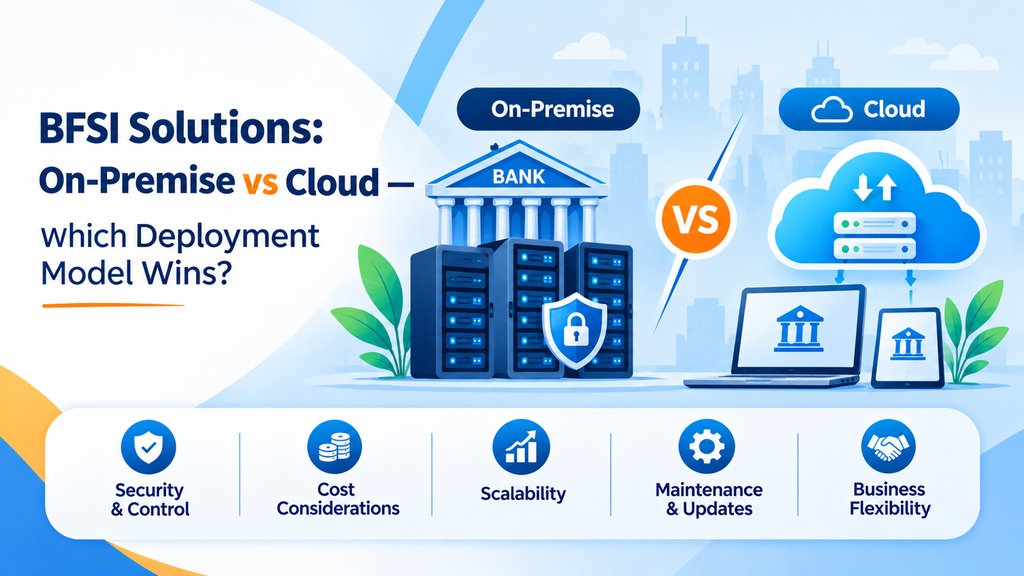
With an on-premise model, the software runs on servers that the institution owns or controls, usually in its own data center. The institution is responsible for hardware, installation, maintenance, upgrades, and security of that environment.
With a cloud model, the software runs on infrastructure provided and managed by a third party. The institution accesses it over a network and relies on the provider for the underlying hardware and, depending on the arrangement, much of the maintenance.
There are also hybrid arrangements, where some systems stay in-house and others move to the cloud. Many institutions end up here, simply because their systems were built at different times and have different needs.
The Case for On-Premise
On-premise deployment has real strengths, which is why it remains common in financial services.
- Direct control over data and infrastructure. Sensitive customer and transaction data stays within systems the institution manages directly.
- Easier alignment with internal policies. Some institutions have security or audit rules that are simpler to satisfy when they control the whole environment.
- Fit with existing core systems. If key systems already run in the institution’s own data center, keeping new applications nearby can simplify integration.
The trade-offs are also clear. On-premise setups usually require upfront investment in hardware, a skilled team to run it, and effort for every upgrade. Scaling up for a busy period can mean buying capacity that sits idle the rest of the year.
The Case for Cloud
Cloud deployment has become attractive for a different set of reasons.
- Flexibility to scale. Capacity can be adjusted as business volumes change, rather than being fixed by what was purchased in advance.
- Lower infrastructure burden. The institution spends less time and effort managing servers and more on the business itself.
- Speed. New applications can often be brought online faster when there is no hardware to procure and set up.
Cloud also brings its own questions. Institutions need to understand where their data is stored, how access is controlled, what the provider is responsible for, and how regulatory expectations on data and outsourcing apply to them. These expectations vary, so compliance and legal teams should be part of the decision from the start.
Where the Industry Is Heading
The direction of travel is visible in how technology services are described. Winsoft’s digital transformation services, for example, are positioned around creating exceptional customer experiences using analytics, automation, and cloud, combined with the right mix of industry expertise. Cloud is treated as one of the core building blocks of modern customer experience, alongside analytics and automation.
At the same time, many financial applications are now built as web-based systems. SmartASBA, for instance, is described as a fully automated, web-based, open-source architecture solution with a web-responsive user interface and an API-based architecture for integrating with other channels. Web-based design makes applications easier to access across devices and easier to connect with other systems, which is useful under either deployment model.
A Practical Way to Decide
Rather than asking which model wins in general, ask which model wins for your institution. These questions help.
- What do regulators and auditors expect for our data? Involve compliance early and get clear guidance on data location, outsourcing, and control requirements.
- What do our existing systems look like? Check where your core banking and other key systems run, and how easily a new solution can connect to them.
- What skills do we have in-house? Running on-premise infrastructure requires dedicated people. If that capacity is limited, the burden of ownership matters.
- How variable is our workload? Businesses with sharp peaks, such as periods of heavy application volume, may benefit from the ability to scale capacity.
- What is our total cost over several years? Compare hardware, staffing, upgrades, support, and subscription costs together, not just the first-year price.
- How quickly do we need to move? Time to launch can be a deciding factor for new products or channels.
- What are our exit and continuity plans? Ask how data can be retrieved, how outages are handled, and what happens if you change providers.
Score each model against these questions, with extra weight for the points that matter most to your business.
Don’t Ignore Integration
Whatever model you choose, the software must connect to the rest of your environment. Banking and capital market solutions, for example, often need to work with core banking systems, payment gateways, messaging services, and external bodies. Strong integration is what keeps data flowing without manual re-entry.
When you review vendors, ask about the integration approach directly: which systems the solution connects with, whether connections are API-based or file-based, and who handles the integration work. This is just as important as the hosting model, and weak integration can undermine either choice. Institutions comparing broader Banking Technology Solutions should treat integration as a core selection criterion.
Planning the Transition
A move from on-premise to cloud, or the reverse, is rarely a single event. Many institutions run both for a period, migrate in stages, and keep some systems where they are.
A sensible approach is to start with a clear inventory of applications, rank them by importance and sensitivity, and decide the order of change. Pilot with a lower-risk system first, learn from it, and then proceed to more critical ones. Treat this as part of your broader Digital Transformation Services plan, so that deployment choices support your customer experience and operating goals, rather than being decided in isolation.
Migrations and integrations also need skilled hands. Institutions often add IT Staff Augmentation during these phases, bringing in technical resources for the period they are needed without long-term hiring.
Common Mistakes to Avoid
- Choosing on cost alone. The cheapest option on paper can become expensive once support, upgrades, and staffing are included.
- Assuming one model fits everything. Different applications may suit different deployments.
- Leaving compliance until the end. Regulatory review should start at the beginning of the evaluation.
- Underestimating migration effort. Data, integrations, and training all take time.
- Ignoring exit options. Plan for how you would move away before you commit.
Conclusion
On-premise and cloud both have a place in financial services, and neither wins in every situation. On-premise offers direct control and close alignment with existing systems, while cloud offers flexibility, speed, and a lighter infrastructure burden. The better choice for your institution depends on regulation, current systems, internal skills, workload patterns, and long-term cost.
Evaluate both models against your own priorities, bring compliance and technology teams into the discussion early, and treat integration and migration planning as seriously as the deployment decision itself. The institutions that decide this carefully end up with technology that supports their business instead of limiting it.