Every BFSI technology project reaches the same question sooner or later: who will do the work? An internal team may be stretched thin, a deadline may be fixed by a regulator or a launch date, and the skills you need may not exist in-house. The two most common answers are to add people to your existing team or to hand the work to an outside party.
These two routes are often confused, but they work very differently. Choosing the wrong one can mean lost control, rising costs, or a project that stalls halfway. This guide explains both models in plain terms and offers a practical way to decide, with a focus on banks, insurers, pension distributors, and wealth management firms.
What IT Staff Augmentation Means
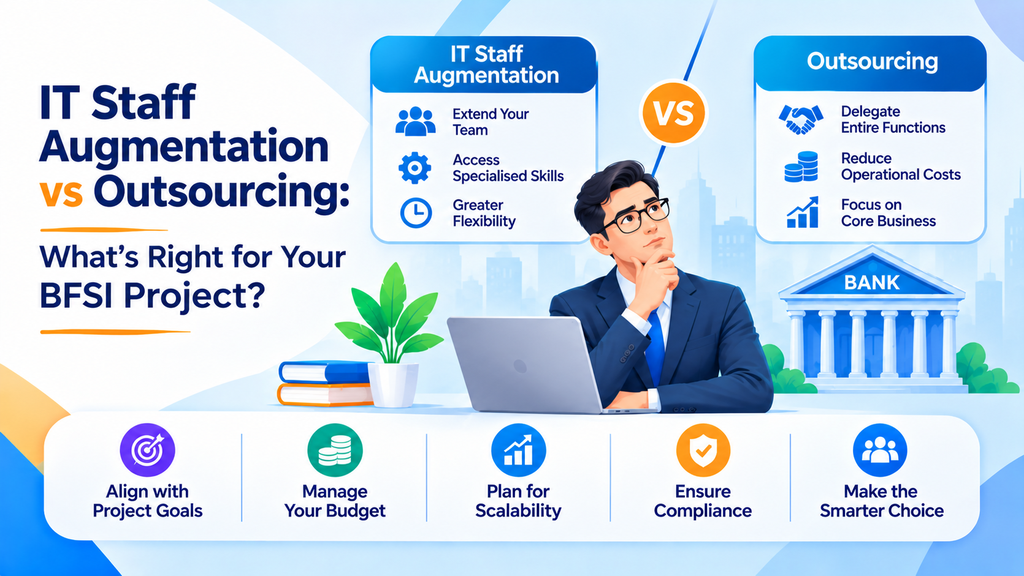
IT Staff Augmentation means adding skilled technical people to your own team for a defined period. These people work under your direction, follow your processes, and become part of your project. You decide what they work on, how the work is reviewed, and how it fits into your wider plan.
Winsoft describes its staff augmentation service as talented and technical resources who can fulfill short-term and long-term IT staffing needs. That short and long-term flexibility is the heart of the model: you add capacity when you need it and scale back when you do not.
What Outsourcing Means
Outsourcing means handing a piece of work, or an entire project, to an external provider who takes responsibility for delivering it. You set the requirements and review the result, but the provider manages the people, the process, and the day-to-day execution.
In this model, you are buying an outcome rather than extra hands. The provider decides how to staff and organize the work, and you rely on their management to meet the agreed scope, timeline, and quality.
A related approach is the turn-key project, where a provider delivers a complete solution from start to finish. Winsoft’s turn-key and product re-engineering services, for instance, are backed by 25+ years of expertise in managing a customer’s application life-cycle.
The Core Difference: Who Controls the Work
The simplest way to separate the two is to ask who manages the work.
- With staff augmentation, you manage. The added people sit inside your team, and you stay in control of priorities, decisions, and knowledge.
- With outsourcing, the provider manages. You define what you need and check the outcome, but the provider runs the work.
Almost every other difference flows from this one. Control, cost structure, speed of change, risk, and knowledge retention all depend on where management sits.
Comparing the Two Models
| Factor | IT Staff Augmentation | Outsourcing |
| Management | Your team directs the work | Provider directs the work |
| Control over decisions | High | Lower, set by contract scope |
| Flexibility to change direction | High | Often needs scope changes |
| Knowledge stays with | Your organization | Often shared with or held by the provider |
| Internal management effort | Higher | Lower |
| Best for | Filling skill or capacity gaps | Delivering defined projects or functions |
When Staff Augmentation Fits Best
Staff augmentation tends to work well in these situations:
- You already have a clear plan and a capable team lead. You mainly need extra hands or a missing skill.
- The scope will change as you learn. BFSI projects often evolve with regulatory updates and business feedback, and an augmented team adapts easily.
- You want knowledge to stay in-house. Because the work happens inside your processes, your own people learn alongside the added resources.
- You face a temporary peak. Integration, testing, and rollout phases often need extra capacity for a limited time.
- Security and data control are priorities. Working inside your own environment and processes can make governance simpler.
When Outsourcing Fits Best
Outsourcing is usually a better fit when:
- The scope is well defined. If requirements are stable, a provider can commit to delivery.
- You lack management capacity. Outsourcing reduces the burden on your own leaders.
- The work is outside your core. Non-strategic functions can be handled by specialists.
- You want a complete result. A turn-key approach suits projects where you want a finished solution rather than a team to manage.
- You need to reduce the number of internal hires for a specific function.
The Trade-Offs to Weigh
Neither model is free of downsides.
Staff augmentation asks more of you. You need people who can direct, review, and integrate the added resources. If your management layer is thin, extra headcount alone will not solve the problem. You also remain accountable for the final outcome.
Outsourcing gives you less day-to-day visibility. Changes to scope can be slow or costly, and knowledge may build up on the provider’s side rather than yours. For regulated work, you also need clear arrangements for data, security, and audit.
Questions That Help You Decide
Use these questions to move from theory to a decision.
- How clear is our scope? Clear and stable points toward outsourcing, while evolving points toward augmentation.
- Do we have people who can manage the work? If yes, augmentation is realistic. If not, outsourcing may be safer.
- Where should knowledge live after the project? If you want it in-house, augmentation helps.
- How sensitive is the data and process? Consider your security, audit, and regulatory obligations.
- How long do we need the extra capacity? Short, defined periods suit augmentation, and ongoing functions may suit outsourcing.
- What does the total cost look like? Compare management effort, rework, and change costs, not only the rate.
- How quickly do we need to start? Adding individuals can be quicker than setting up a full outsourced engagement.
Typical BFSI Scenarios
Different projects point toward different choices.
- Integration of a new platform with core banking. The scope depends on your internal systems, so augmentation lets your team lead the work while adding technical depth.
- Testing before a launch. A short, intense need for capacity suits augmentation. If you prefer to hand the whole job to specialists, a dedicated testing engagement fits too. Winsoft’s Testing Services are described as ensuring robust and reliable software applications through quality engineering and holistic testing.
- A full application build or re-engineering effort. If you want a finished result and have limited internal capacity, a turn-key approach may suit you better.
- A multi-year modernization program. This often mixes both: internal leads, augmented specialists for peak phases, and outsourced work for clearly defined pieces. Programs of this kind are often part of broader Digital Transformation Services, which align customer experience goals, technology, and operating models.
It Does Not Have to Be Either/Or
Many institutions combine the two. A bank might outsource a defined application build while using augmented staff to handle integration with its own systems. An insurer might keep strategic design in-house, augment its team for testing, and outsource a standalone tool.
The aim is to match each part of the work to the model that fits it. Treat the choice as a decision for each piece, not a single policy for the entire organization.
Common Mistakes to Avoid
- Choosing on rate alone. The cheapest hourly cost can become expensive if management or rework costs rise.
- Using augmentation without management capacity. Extra people need direction.
- Outsourcing an unclear scope. Vague requirements lead to disputes and change requests.
- Ignoring knowledge transfer. Plan how knowledge will stay with your organization, whichever model you choose.
- Skipping governance. In BFSI, clear rules on data access, security, and audit matter in both models.
Conclusion
IT staff augmentation and outsourcing solve different problems. Augmentation adds capacity and skills under your own control, which suits evolving scope, short-term peaks, and teams that want to keep knowledge in-house. Outsourcing transfers responsibility for delivery, which suits well-defined work and organizations with limited management capacity.
For a BFSI project, the right answer depends on scope clarity, internal management strength, data sensitivity, duration, and total cost. Answer those questions honestly, consider a mix of both models where it makes sense, and choose the approach that gives your project the best chance of finishing on time with the quality your customers and regulators expect.